A great logo is more than just a design. It represents your brand, communicates your identity, and creates a lasting impression. Whether you’re running a clothing brand, managing a sports team, promoting a business, or designing personalized accessories, every detail of your logo matters.
But what happens when your design includes tiny lettering, intricate illustrations, thin lines, or multiple colors? Traditional embroidery may struggle to reproduce these elements clearly, especially when the patch is small.
That’s where custom woven patches become an excellent solution.
Woven patches are designed to capture fine details, sharp lettering, and complex artwork using tightly woven threads. Unlike conventional embroidered patches, which rely on raised stitching, woven patches create a smoother, flatter surface that allows intricate designs to appear more precise.
At Patches Maker USA, we understand how important accurate logo reproduction is for businesses, clothing brands, organizations, and creative professionals. Choosing the right patch style can make a significant difference in how your design looks on finished merchandise.
In this guide, we’ll explore why woven patches are a smart choice for detailed logos and small text, how they compare with embroidered patches, where they work best, and what to consider when creating your own custom design.
What Are Woven Patches?
Woven patches are fabric-based patches created by interlacing fine threads to reproduce a design directly within the material.
Instead of stitching a logo onto an existing fabric surface, the design becomes part of the woven structure itself. This production technique allows manufacturers to create detailed patterns with relatively thin threads and a tight weave.
The result is a lightweight, smooth patch that can display complicated graphics without the bulky texture commonly associated with traditional embroidery.
Key Features of Woven Patches
Woven patches offer several characteristics that make them particularly useful for detailed branding:
- Fine detail reproduction: Thin lines, small lettering, and intricate shapes can often be represented more accurately.
- Smooth surface: The tightly woven construction creates a flatter finish than raised embroidery.
- Lightweight feel: Woven patches generally add less bulk to clothing and accessories.
- Clear lettering: Small text can remain readable when the design is properly sized.
- Flexible design options: Different shapes, colors, borders, and attachment methods can be used.
- Professional appearance: The clean finish works well for modern clothing brands and corporate merchandise.
These advantages make woven patches a popular option for projects where visual precision matters more than raised texture.
1. Woven Patches Capture Intricate Logo Details
One of the biggest reasons to choose woven patches is their ability to reproduce complicated artwork.
Modern brand logos often include more than a simple symbol or bold lettering. They may feature delicate outlines, detailed illustrations, geometric shapes, gradients simulated through thread patterns, or multiple design elements positioned close together.
When these designs are converted into traditional embroidery, some details may need to be simplified.
This happens because embroidery uses individual stitches that occupy physical space. When a logo contains extremely narrow gaps or closely positioned lines, the stitching may overlap or obscure smaller elements.
Woven patches use a different construction method.
Fine threads are woven together to create the artwork, allowing smaller details to fit into a relatively compact area.
Examples of Designs That Benefit from Woven Patches
Detailed company logos: Businesses with complicated brand marks can use woven patches to preserve important visual elements.
Illustrated artwork: Designs featuring buildings, landscapes, animals, or detailed objects can benefit from the finer woven structure.
Geometric patterns: Thin outlines, closely spaced shapes, and symmetrical elements can appear cleaner.
Multi-element logos: Designs combining icons, text, borders, and decorative graphics can be easier to reproduce without excessive bulk.
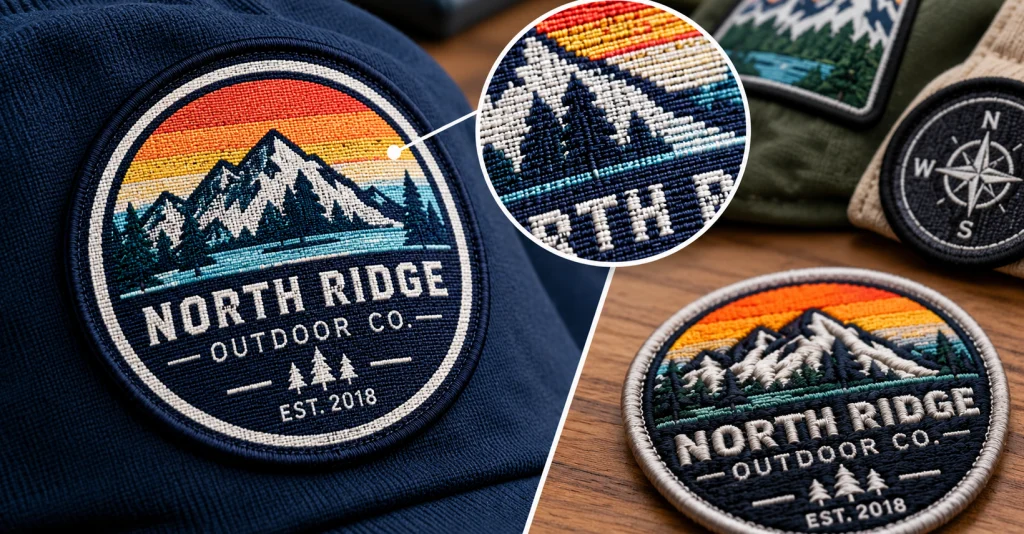
For example, imagine a clothing brand using a circular logo containing a mountain illustration, the company name, and a small establishment date.
An embroidered patch may require thicker lettering or simplified mountain lines. A woven patch can often preserve more of the original design within the same dimensions.
This makes woven patches a practical option for businesses that want their branding to remain visually consistent.
2. Small Text Looks Clearer on Woven Patches
Small lettering is one of the most challenging elements in custom patch manufacturing.
A logo may include a website address, slogan, location, founding year, product name, or secondary brand message. These details can become difficult to read when reproduced on a compact patch.
With traditional embroidery, the thickness and direction of stitches can affect how clearly letters appear.
Certain characters, especially those containing narrow spaces or curved shapes, may lose definition.
Letters such as a, e, o, s, and g can be particularly challenging at very small sizes because their internal openings need enough space to remain visible.
Woven patches offer an advantage because their finer thread structure can produce more defined lettering.
Why Woven Patches Work Well for Small Text
Better letter definition: Fine threads allow more precise separation between individual characters.
Cleaner spacing: Small gaps between letters can remain more visible.
Improved consistency: Lettering can appear more uniform across the design.
Less raised texture: A flatter surface reduces the visual bulk that may affect tiny embroidered text.
However, woven patches still have physical limitations. Extremely small lettering may need to be enlarged, simplified, or adjusted for manufacturing.
At Patches Maker USA, we encourage customers to consider readability during the design process rather than simply reducing their artwork to the smallest possible dimensions.
A well-designed woven patch should look attractive and remain easy to recognize at normal viewing distance.
3. Woven Patches Provide a Smooth, Professional Finish
Texture plays an important role in how a patch looks and feels.
Embroidered patches are known for their raised stitching and traditional appearance. This texture can be desirable for bold logos, military-inspired designs, and classic team patches.
However, not every brand wants a raised or heavily textured finish.
Some businesses prefer a smoother appearance that blends naturally with their clothing or accessories.
Woven patches provide that alternative.
Because the design is formed through tightly interlaced threads, the surface is generally flatter and more uniform.
Benefits of a Smooth Patch Surface
A smooth finish can make detailed logos easier to interpret because the viewer sees the overall design without prominent stitching patterns.
It also creates a refined appearance that works particularly well with modern apparel.
Fashion labels, lifestyle brands, streetwear companies, and corporate organizations may prefer woven patches when they want subtle branding.
For example, a minimalist clothing brand might use a small rectangular woven patch featuring a thin logo and understated typography.
Instead of drawing attention through raised texture, the patch communicates quality through clean lines and careful detailing.
This makes woven patches suitable for brands that prioritize precision, simplicity, and consistency.
4. They Are Ideal for Complex Logos with Multiple Colors
Color is an essential part of brand recognition.
Customers often associate specific color combinations with their favorite businesses, teams, and products.
When designing custom patches, preserving these colors can help maintain a consistent brand identity.
Woven patches can incorporate multiple thread colors into a single design, making them useful for colorful logos and illustrations.
Because the threads are woven into the patch, different colors can be positioned close together without relying on thick embroidered stitching.
Where Color Detail Matters Most
Corporate branding: Companies may need to reproduce recognizable brand colors across uniforms and promotional merchandise.
Fashion collections: Clothing designers may use multiple shades to create decorative artwork.
Sports organizations: Team logos frequently combine lettering, symbols, and contrasting colors.
Event merchandise: Festivals, conventions, and promotional campaigns often require distinctive artwork.
It’s important to understand that woven patches cannot reproduce every printed color effect exactly.
Photographic gradients, transparent elements, and extremely subtle color transitions may require artwork adjustments.
Thread availability can also influence the final color match.
For the best results, customers should provide clear artwork and identify important brand colors before production.
5. Woven Patches Are Lightweight and Comfortable
A custom patch should look great, but it should also work well with the product it is attached to.
Heavy or bulky patches may not be ideal for every garment.
This is especially important for lightweight clothing, flexible accessories, and products designed for everyday comfort.
Woven patches are generally thinner and lighter than traditional embroidered patches of similar size.
Their flatter construction can make them more suitable for applications where flexibility matters.
Popular Lightweight Applications
T-shirts and casual clothing: Small woven patches can add branding without creating excessive bulk.
Caps and hats: Detailed woven logos can provide a clean appearance on headwear.
Jackets: Woven patches can be used for decorative branding, sleeve details, and identification.
Backpacks: Compact woven logos can create a professional finish on bags and accessories.
Fashion accessories: Small woven patches can be incorporated into fabric accessories and lifestyle products.
For example, a clothing brand creating lightweight summer garments may prefer a thin woven patch over a heavily embroidered design.
The woven option can provide recognizable branding while maintaining a relatively low-profile appearance.
Comfort and flexibility also depend on the backing material, patch size, and attachment method, so these factors should be considered together.
6. Woven Patches Help Maintain Brand Consistency
Consistency is one of the most important elements of professional branding.
Your logo should remain recognizable whether it appears on your website, packaging, employee uniforms, or promotional products.
When a detailed logo is simplified too aggressively for manufacturing, the finished patch may look noticeably different from the original design.
This can create inconsistencies across branded merchandise.
Woven patches help address this challenge by allowing more fine details to be retained.
Why Consistent Logo Reproduction Matters
A recognizable logo helps customers identify your business quickly.
Consistent branding also contributes to a more professional presentation, especially when products are distributed across multiple locations or collections.
Imagine a company that uses the same detailed emblem on staff uniforms, promotional caps, and branded backpacks.
By using woven patches with consistent artwork, dimensions, and thread specifications, the business can achieve a more coordinated appearance across its merchandise.
For clothing brands, this consistency is particularly valuable.
Customers expect logos, labels, and decorative details to reflect the same identity across different products.
Woven patches offer a practical way to support that visual consistency without sacrificing important details.
7. Woven Patches vs. Embroidered Patches: What’s the Difference?
Both woven and embroidered patches are popular choices for custom branding.
However, they serve slightly different design purposes.
Understanding these differences can help you select the most appropriate option.
| Feature | Woven Patches | Embroidered Patches |
|---|---|---|
| Fine details | Excellent for intricate artwork | Better for simpler, bolder designs |
| Small text | Often clearer at smaller sizes | Usually requires larger lettering |
| Surface texture | Smooth and flat | Raised and textured |
| Thickness | Generally thinner | Generally thicker |
| Visual style | Clean and precise | Traditional and dimensional |
| Best applications | Detailed logos and small lettering | Bold emblems and classic patches |
| Thread appearance | Fine woven structure | Visible embroidery stitches |
| Flexibility | Often more flexible | Depends on stitch density and backing |
When Should You Choose Woven Patches?
Choose woven patches when your design includes:
- Small text or fine typography
- Detailed illustrations
- Thin outlines
- Multiple closely positioned elements
- Complex logos
- A preference for a smooth, low-profile finish
When Are Embroidered Patches Better?
Embroidered patches may be the better option when your design includes bold lettering, large symbols, simple shapes, or when you specifically want raised thread texture.
Neither patch style is universally better.
The right choice depends on your artwork, intended application, preferred appearance, and budget.
At Patches Maker USA, our goal is to help customers understand these differences so they can select a patch style that complements their design.
8. Best Uses for Custom Woven Patches
Woven patches are versatile enough for many industries and applications.
Their combination of detailed artwork reproduction and a smooth finish makes them useful for both commercial and personal projects.
Clothing Brands and Streetwear Labels
Fashion brands frequently use woven patches to add recognizable branding to garments.
Small logos, collection names, slogans, and decorative illustrations can be incorporated into patches for jackets, hoodies, shirts, and headwear.
For streetwear businesses, woven patches can provide a distinctive branded detail without overwhelming the garment.
A small woven logo on a sleeve or near the hem can create a subtle but recognizable finishing touch.
Corporate Uniforms and Workwear
Businesses often need employee uniforms that display company logos clearly.
When the logo includes small text or complicated artwork, woven patches can be a practical solution.
They can be used on shirts, jackets, workwear, and other suitable garments.
A well-positioned woven patch helps maintain a consistent professional appearance across staff uniforms.
Sports Teams and Clubs
Sports organizations often require patches featuring team names, logos, dates, and decorative elements.
Woven patches can be useful when a team emblem includes detailed graphics or smaller lettering.
They can be applied to suitable jackets, bags, caps, and other team merchandise.
Schools and Educational Organizations
School clubs, academic societies, and student organizations may use woven patches to represent their identities.
Detailed crests, institutional names, and event-specific designs can benefit from the precision of woven construction.
Promotional Merchandise
Businesses use branded merchandise to increase visibility and create memorable promotional products.
Woven patches can be incorporated into giveaways, event accessories, bags, and apparel.
Their compact size and detailed appearance make them particularly useful for merchandise featuring intricate logos.
Personalized Gifts and Accessories
Custom woven patches are not limited to commercial branding.
Individuals can use them for personalized clothing, hobby clubs, commemorative items, and creative projects.
Names, meaningful dates, symbols, and original artwork can all become part of a custom woven design.
9. Customization Options for Woven Patches
One of the most appealing features of woven patches is their design flexibility.
Customers can personalize various aspects of their patches to match their branding requirements.
Custom Shapes and Sizes
Woven patches can be produced in a variety of shapes, including circles, squares, rectangles, ovals, and custom outlines.
The ideal shape depends on the artwork and where the patch will be attached.
For example, rectangular patches often work well for wordmarks, while circular patches are popular for emblems and club logos.
Thread Colors
Multiple thread colors can be used to reproduce different elements of a design.
Customers should provide their preferred colors and identify any critical brand shades.
Border Styles
The border helps define the patch’s shape and contributes to its finished appearance.
Common options include merrowed borders for suitable shapes and laser-cut or heat-cut edges for more intricate outlines.
The best border depends on the patch’s design and construction.
Backing Options
Different attachment methods can be considered depending on the intended use.
Sew-on backing: A practical choice for permanent attachment to garments and accessories.
Iron-on backing: A heat-activated option for compatible fabrics, subject to the manufacturer’s application instructions.
Hook-and-loop backing: Useful for patches that need to be removed or replaced, such as certain uniforms and bags.
Adhesive backing: Suitable for some temporary or specialized applications, depending on the material and adhesive.
Not every backing option is appropriate for every product, so the intended application should be discussed before ordering.
10. How to Design Woven Patches for the Best Results
Even though woven patches can reproduce fine details, thoughtful artwork preparation is essential.
A design that looks perfect on a computer screen may need adjustments before it can be manufactured using thread.
Here are several important considerations.
Start with High-Quality Artwork
Whenever possible, provide a vector logo or a high-resolution design file.
Vector artwork is especially useful because it allows shapes and lettering to be adjusted without losing clarity.
Common design formats include AI, EPS, SVG, PDF, and high-resolution PNG files, depending on the manufacturer’s requirements.
Choose the Right Patch Size
A larger patch generally provides more room for detailed elements.
If your logo includes extremely small text, increasing the patch size may improve readability.
The best dimensions depend on the design’s complexity and the limitations of the weaving process.
Avoid Extremely Thin Details
Although woven patches support fine lines, there is still a minimum practical thread resolution.
Lines that are too thin may disappear or merge into surrounding colors.
Small adjustments can help preserve the intended appearance.
Maintain Good Color Contrast
Text should stand out clearly from its background.
For example, light lettering on a dark background can be easier to read than two similar shades positioned together.
Good contrast is particularly important for small lettering.
Review a Digital Proof
A digital proof can help identify potential issues with text spacing, logo proportions, border placement, and color distribution.
Customers should review the artwork carefully before approving production.
Consider a Physical Sample
For complex designs or large orders, a physical sample may be helpful when available.
It allows customers to evaluate the actual woven texture, lettering clarity, thread colors, and overall appearance.
Taking time to review these details can reduce the likelihood of disappointment with the finished patches.
11. Are Woven Patches Durable?
Durability is an important consideration when purchasing custom patches.
Businesses want branded merchandise that maintains its appearance during normal use.
Woven patches can provide reliable durability when produced with suitable materials and attached correctly.
Because the design is integrated into the woven fabric, the artwork is not simply printed onto the surface.
However, overall durability depends on several factors.
Thread and Material Quality
The type and quality of thread can affect the patch’s appearance and resistance to wear.
Attachment Method
A properly sewn patch can provide a secure attachment for many garment applications.
Heat-applied patches depend on correct application conditions and fabric compatibility.
Washing and Maintenance
Garments featuring woven patches should be cared for according to the patch and garment manufacturers’ instructions.
Excessive heat, harsh cleaning chemicals, and inappropriate washing methods may affect the patch or its backing.
Intended Environment
A patch used on casual clothing may experience different conditions from one attached to outdoor equipment or workwear.
Choosing suitable materials and attachment methods for the intended environment is important.
With appropriate construction and care, woven patches can remain an attractive branding element over time.
12. Are Woven Patches Cost-Effective for Businesses?
Cost is an important factor when selecting custom branding products.
The price of woven patches depends on several variables, including size, design complexity, thread colors, quantity, backing, and finishing requirements.
For designs containing intricate details, woven patches may offer a practical alternative to embroidery because they can reduce the need to simplify artwork.
However, woven patches are not automatically cheaper than embroidered patches.
The most cost-effective choice depends on the specifications of the project.
Factors That Influence Woven Patch Pricing
Patch dimensions: Larger patches typically require more material.
Order quantity: Higher quantities may reduce the average cost per patch.
Artwork complexity: Detailed designs can influence manufacturing requirements.
Color requirements: The number and type of thread colors may affect production.
Backing selection: Different attachment methods can have different costs.
Border and finishing: Custom shapes and specialized finishes may influence pricing.
Businesses should compare options based on both price and the quality of the finished design.
A patch that reproduces the brand logo accurately can provide better overall value than a less expensive option that requires major design compromises.
For specific pricing, customers can submit their artwork and requirements to Patches Maker USA for a customized quotation.
13. Why Woven Patches Are Popular with Modern Clothing Brands
Today’s clothing market places significant emphasis on branding details.
Customers notice more than the main garment design. They also pay attention to logos, labels, stitching, trims, and finishing.
Woven patches give clothing brands another way to communicate their identity.
Their flat construction works particularly well with contemporary designs that favor clean typography and subtle visual details.
A Refined Look for Premium Apparel
A small woven patch can make a simple garment feel more intentionally designed.
For example, a heavyweight hoodie featuring a carefully positioned woven logo patch may create a different impression from one with a large printed graphic.
Both approaches have value, but woven patches offer a distinct textile finish.
Suitable for Limited-Edition Collections
Fashion businesses often release seasonal or limited-edition collections.
Custom woven patches can feature collection names, special symbols, or commemorative dates.
This creates an opportunity to distinguish one collection from another while maintaining a consistent brand identity.
Branding Across Different Products
A clothing company can use coordinated woven patches across hoodies, jackets, hats, and bags.
This helps establish a recognizable visual connection between products.
For emerging brands, consistent design details can contribute to a more cohesive product range.
14. Common Mistakes to Avoid When Ordering Woven Patches
Woven patches offer excellent design possibilities, but certain mistakes can affect the final result.
Understanding these issues before placing an order can help improve your experience.
Choosing a Patch That Is Too Small
A complicated logo may contain more information than can fit clearly into a tiny patch.
If the design becomes overcrowded, important details may lose definition.
Consider increasing the patch size or simplifying less important elements.
Using Low-Resolution Artwork
Blurry artwork can make it difficult to determine the correct shapes and spacing.
Provide the clearest available logo file to support accurate design preparation.
Ignoring Letter Spacing
Small text needs sufficient spacing between characters.
If letters are positioned too closely, they may become difficult to distinguish once woven.
Selecting Poor Color Combinations
Colors with insufficient contrast can reduce readability.
Choose thread colors that help important design elements stand out.
Forgetting About the Application Surface
A patch intended for a cap may require different dimensions or placement considerations from one intended for a jacket.
Think about the finished product before selecting the patch size and shape.
Approving Artwork Without Checking Details
Always inspect the spelling, proportions, colors, and placement shown in your proof.
Even a small mistake in a company name or website address can affect the usefulness of the finished patches.
15. How to Order Custom Woven Patches from Patches Maker USA
Creating custom woven patches begins with a clear idea of your design and how you plan to use it.
At Patches Maker USA, we aim to make it easier for customers to explore patch options that suit their branding and customization needs.
Before requesting a quotation, prepare the following information.
Step 1: Choose Your Design
Select the logo, illustration, lettering, or artwork you want reproduced.
If your design includes small text or detailed elements, identify which features must remain clearly visible.
Step 2: Decide on Your Patch Size
Consider where the patch will be attached and how much space is available.
A patch for a shirt sleeve may need different dimensions from a patch for a backpack.
Step 3: Select Your Colors and Shape
Choose a shape that complements the artwork.
Identify your preferred thread colors and any important branding requirements.
Step 4: Consider the Backing
Think about whether the patch will be permanently sewn onto a garment or requires another attachment method.
Step 5: Share Your Requirements
Provide your artwork, preferred dimensions, quantity, and customization details when requesting a quote.
Clear specifications help ensure that the proposed patch matches your intended application.
Step 6: Review the Design Before Production
Check the final artwork or proof carefully.
Pay particular attention to small lettering, fine lines, spacing, and overall proportions.
Once the specifications are approved, the design can proceed according to the agreed production arrangements.
16. Why Choose Patches Maker USA for Custom Woven Patches?
When investing in custom patches, selecting the right design and manufacturing approach is just as important as choosing the patch type.
At Patches Maker USA, we understand that customers want their logos to look recognizable, professional, and suitable for their intended products.
Whether you’re developing merchandise for a clothing brand, preparing promotional accessories, or creating patches for an organization, attention to detail matters.
Our focus is on helping customers explore customized patch solutions that reflect their artwork and intended use.
Designed Around Your Branding
Every logo has different requirements.
Some designs need bold colors and prominent symbols, while others depend on tiny lettering and intricate illustrations.
Woven patches offer a useful solution for projects where maintaining these details is a priority.
Suitable for Different Applications
From apparel branding to promotional merchandise, woven patches can support a wide range of creative projects.
Customers can consider different shapes, sizes, colors, and attachment methods to suit their products.
A Practical Choice for Detailed Artwork
Rather than automatically simplifying every complex logo into thick embroidery, woven construction provides an alternative that can preserve more of the original artwork.
This makes it particularly valuable for customers who want precise branding on compact patches.
Customization for Your Project
Whether you need patches for a business, clothing collection, club, or personal design, providing clear artwork and specifications is the first step toward achieving a suitable result.
Explore the possibilities with Patches Maker USA and discover how custom woven patches can complement your branding.
Frequently Asked Questions About Woven Patches
1. Are woven patches better than embroidered patches for small text?
Woven patches are generally better suited to small lettering because their fine thread construction allows more precise details. However, readability still depends on font style, letter spacing, and patch size.
2. Can woven patches reproduce detailed company logos?
Yes. Woven patches are well suited to many detailed logos, including designs featuring thin lines, multiple elements, and compact lettering. Extremely fine artwork may still require adjustments.
3. Do woven patches have a raised texture?
Woven patches typically have a smooth, flat surface compared with traditional embroidered patches. They do not produce the same prominent raised stitching effect.
4. Can woven patches be made in custom shapes?
Yes. Common shapes include circles, squares, rectangles, and ovals. More complicated outlines may also be possible depending on the design and finishing method.
5. Are woven patches suitable for hats and caps?
Yes. Woven patches can be used on various types of headwear, including baseball caps, trucker caps, and other suitable styles. The ideal patch dimensions depend on the available placement area.
6. Can woven patches be ironed onto clothing?
Woven patches can be manufactured with compatible heat-activated backing. Application requirements depend on the backing material and garment fabric.
7. Are woven patches washable?
Many woven patches can withstand appropriate garment washing, but care requirements depend on their materials, backing, and attachment method. Always follow the relevant care instructions.
8. What is the best file format for a woven patch design?
Vector artwork such as AI, EPS, SVG, or suitable PDF files is often preferred. High-resolution PNG artwork may also be useful, depending on the design.
9. Can woven patches include multiple colors?
Yes. Woven patches can incorporate multiple thread colors. The available palette and achievable effects depend on production specifications.
10. How much do custom woven patches cost?
Pricing varies according to patch size, quantity, design complexity, backing, and finishing requirements. Requesting a customized quotation is the best way to determine the cost of your project.
Final Thoughts: Make Every Detail Count with Custom Woven Patches
When your logo includes intricate illustrations, thin lines, small lettering, or carefully positioned design elements, choosing the right patch style can make a major difference.
Woven patches offer a combination of fine detail reproduction, smooth texture, lightweight construction, and versatile customization.
They are especially valuable for businesses and designers who want their logos to remain recognizable on compact patches.
While traditional embroidery continues to be an excellent option for bold, textured designs, woven patches provide a smart alternative when precision and clarity are the priorities.
From fashion labels and corporate uniforms to sports merchandise and personalized accessories, woven patches can help transform detailed artwork into practical textile branding.
At Patches Maker USA, we believe that even the smallest design elements deserve attention.
Ready to Create Your Own Custom Woven Patches?
Give your detailed logo the finish it deserves.
Whether you’re designing patches for a clothing brand, business, sports team, or promotional collection, explore custom woven patch options that bring your artwork to life.