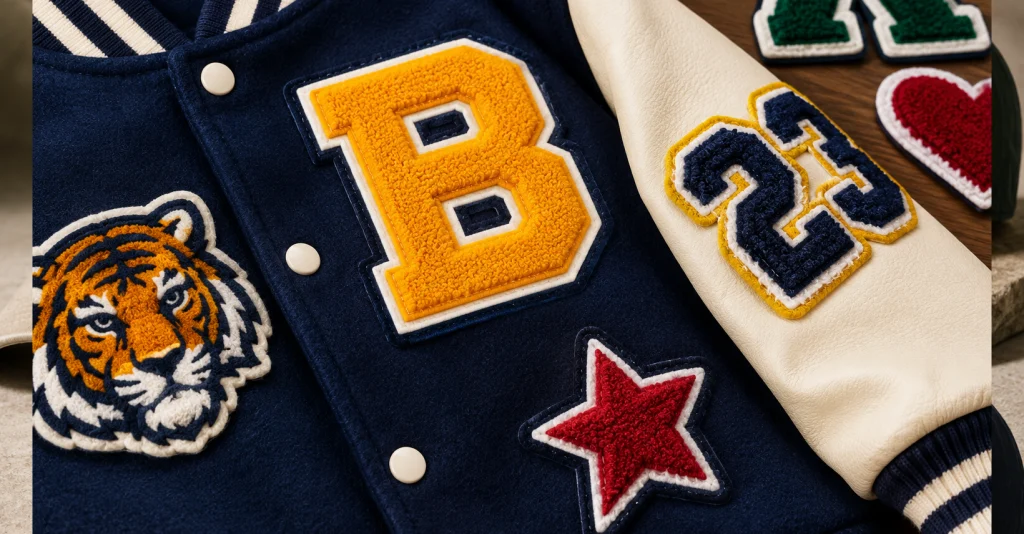
Chenille patches are a popular choice for anyone who wants to add texture, color, and personality to clothing, accessories, and branded merchandise. Recognized for their soft, raised surface and bold appearance, these patches are especially popular on varsity jackets, letterman jackets, school apparel, sports uniforms, hoodies, and streetwear. Unlike traditional flat designs, chenille patches create a plush finish that makes letters, numbers, mascots, and logos stand out.
At Patches Maker USA, we understand that the right patch should do more than decorate a garment. It should represent a team, communicate a brand identity, celebrate an achievement, or turn an ordinary piece of clothing into something distinctive. Custom chenille patches offer a versatile way to achieve these goals through personalized shapes, colors, lettering, and finishing options.
Whether you are designing varsity letters for a school, creating merchandise for a clothing brand, preparing awards for a sports team, or adding a unique feature to your own apparel, understanding chenille patches will help you make the right decisions.
This guide explains what chenille patches are, how they are made, their advantages, available styles, backing options, applications, and the factors to consider when ordering custom patches.
What Are Chenille Patches?
Chenille patches are decorative fabric patches made with yarn loops that create a thick, soft, and textured surface. The name chenille comes from a French word meaning caterpillar, a reference to the fuzzy appearance of the yarn.
The construction gives these patches their recognizable raised finish. Instead of relying entirely on flat stitching or printing, chenille designs use textured yarn to create bold shapes, letters, numbers, and other visual elements.
These patches are closely associated with American varsity and letterman jackets, where large school initials, graduation years, athletic symbols, and achievement awards are often displayed on the chest, sleeves, or back.
However, chenille patches are no longer limited to school and college apparel. They are also used by fashion designers, independent clothing brands, sports organizations, clubs, event planners, and businesses that want their products to have a distinctive appearance.
Custom chenille patches can be produced in different sizes, shapes, and color combinations. Depending on the design, they may also incorporate embroidery details to add outlines, lettering, facial features, or smaller decorative elements.
This combination of soft texture and bold design makes chenille an excellent choice for artwork that needs to be noticeable from a distance.
How Are Chenille Patches Made?
Understanding the manufacturing process can help you plan a design that looks attractive and performs well on the intended garment.
Although production methods vary depending on the design and manufacturer, custom chenille patches generally involve several important stages.
1. Reviewing the Artwork
The process begins with your design idea. You can provide a logo, school initial, team mascot, number, lettering concept, or reference image.
The artwork is reviewed to determine whether the design is suitable for chenille construction. Large shapes and bold lettering usually work particularly well because they allow the textured yarn to remain visually prominent.
Very small text, narrow lines, and intricate details may need to be simplified or reproduced with embroidery.
2. Selecting Colors and Materials
Next, the colors and materials are selected according to the desired appearance.
School and sports designs often use two or three contrasting colors to create a recognizable varsity style. Clothing brands may prefer a more restrained palette, such as black and white, neutral shades, or colors that match their existing collection.
The background material and supporting layers also contribute to the patch’s structure. Felt is commonly associated with traditional varsity-style patches because it provides a suitable base for bold letters and shapes.
3. Creating the Chenille Texture
The characteristic surface is created using looped yarn. These loops produce a soft, raised finish that gives the patch its distinctive appearance.
The size, density, and arrangement of the yarn help determine how the finished design looks and feels. Larger filled areas generally provide the most noticeable chenille effect.
4. Adding Embroidery Details
Some designs benefit from a combination of chenille and embroidery.
For example, a large letter can feature a chenille fill with an embroidered outline. A mascot may use chenille for its main body and embroidery for selected facial features or decorative accents.
This combination makes it possible to balance texture with additional definition.
5. Finishing the Border
The patch edges are finished to create a clean outline and help the design maintain its intended shape.
The most suitable border depends on the patch’s shape, thickness, and overall style. Traditional varsity designs often use a substantial, defined edge, while other applications may require a different finish.
6. Reviewing the Finished Design
Before placing a custom order into production, it is important to confirm the artwork, size, colors, border, and backing.
At Patches Maker USA, customers can request a digital proof to review the proposed design before production begins. This provides an opportunity to identify adjustments and ensure that the finished patch matches the intended concept.
Benefits of Choosing Custom Chenille Patches
Custom chenille patches offer several advantages for individuals, schools, sports organizations, and apparel businesses.
1. A Distinctive Raised Texture
The most noticeable advantage is the soft, dimensional surface. Chenille creates a visual and tactile effect that differs from standard printed graphics and flat embroidery.
This makes it particularly useful when you want a design to become a prominent feature of a garment rather than a small decorative detail.
2. Excellent for Bold Lettering
Chenille is especially suitable for large letters, initials, and numbers.
A school initial on a varsity jacket, a graduation year on a sweater, or a team number on a warm-up garment can become a strong visual statement when produced with raised yarn.
For best results, choose lettering that remains easy to recognize at the intended viewing distance.
3. Flexible Customization
Custom chenille patches can be developed around different artwork, colors, shapes, and dimensions.
You can create a traditional varsity letter, a personalized monogram, a sports emblem, or a design that reflects your brand’s identity.
Combining chenille with embroidery can provide even more flexibility when a design needs both large textured areas and smaller details.
4. Suitable for Multiple Applications
Although chenille patches are strongly associated with letterman jackets, they can also be used on hoodies, sweatshirts, bags, club apparel, and selected fashion accessories.
Their suitability depends on the garment’s material, weight, construction, and intended use.
5. Supports Brand Recognition
Businesses and clothing brands need ways to make their products recognizable. A custom patch featuring a logo, monogram, or signature graphic can help create a consistent visual identity.
Chenille can be particularly effective for retro-inspired fashion, premium casualwear, collegiate collections, and streetwear designs.
6. A Personal Way to Celebrate Achievements
Schools, colleges, and sports teams can use chenille patches to recognize participation, milestones, championships, graduation years, and other achievements.
Because designs can be personalized, each patch can represent a specific accomplishment or group identity.
Popular Types of Chenille Patches
The best chenille patch style depends on the message you want to communicate and the item on which the patch will be placed.
Custom Chenille Letter Patches
Letter patches are among the most recognizable chenille designs.
They are commonly used for school initials, college names, team abbreviations, personal monograms, and clothing brand logos.
Large letters with contrasting outlines work particularly well on varsity jackets and sweatshirts. You can select individual letters or combine them into a complete wordmark.
Chenille Number Patches
Number patches are frequently used to display graduation years, team numbers, anniversaries, and commemorative dates.
For example, a school jacket may feature the year of graduation, while a sports organization might use numbers to represent a championship season.
Choose a font with clear, open shapes so that the numbers remain readable when filled with chenille yarn.
Chenille Mascot Patches
Mascot patches help schools, teams, and clubs represent their identity through a recognizable symbol.
Animals, birds, mythical creatures, and simplified character designs can all provide inspiration.
Since chenille is best suited to bold shapes, detailed mascots may benefit from embroidered accents rather than attempting to reproduce every small feature with textured yarn.
Custom Chenille Logo Patches
Businesses and apparel brands can use chenille to create a distinctive version of their logo.
This works particularly well when the logo includes a bold symbol, large initials, or a simple graphic.
If your existing logo contains small text or fine details, a simplified version may produce a better result than reproducing the complete artwork exactly as it appears on a website.
Chenille Name Patches
Personalized name patches can be used for clubs, teams, group apparel, and fashion projects.
The name can be displayed on a jacket, sweatshirt, or other suitable garment. Letter spacing and font selection are important because overly narrow lettering may be difficult to reproduce clearly with a raised texture.
Chenille Award Patches
Schools and organizations can create patches to recognize special achievements.
Possible designs include championship awards, graduation milestones, team participation, leadership recognition, and anniversary celebrations.
Consistent colors and shapes can help create a coordinated collection across different award categories.
Chenille Patches vs. Embroidered Patches
Chenille and embroidered patches are both popular options, but they produce different visual effects.
Chenille patches use looped yarn to create a thick, plush surface. Traditional embroidered patches use stitched thread to form a comparatively flatter design.
Neither option is automatically better for every project. The right choice depends on the artwork and the intended application.
Texture and Appearance
Chenille patches have a soft, raised appearance that makes them easy to distinguish from ordinary embroidery.
Embroidered patches generally provide a more defined stitched finish and can be better suited to designs that require tighter lines or detailed lettering.
Design Complexity
Chenille works best for bold shapes, large letters, numbers, and simple graphics.
Embroidery is usually more suitable for small text, intricate outlines, and detailed logos. It can capture features that would be difficult to reproduce clearly using thick chenille yarn alone.
Typical Applications
Chenille is frequently chosen for varsity jackets, school apparel, fashion pieces, and statement designs.
Embroidery is widely used for uniforms, corporate logos, workwear, caps, and badges that require more detailed stitching.
Which Should You Choose?
Choose chenille when your main priority is a raised texture and a classic varsity appearance.
Choose embroidery when the design depends on fine details or small lettering.
If your artwork includes both large shapes and intricate elements, consider combining the two techniques. This can provide a textured base while preserving important details through embroidery.
Chenille Patches vs. Woven and Printed Patches
Comparing chenille with other patch types can help you select the right construction before requesting a quote.
Chenille vs. Woven Patches
Woven patches use fine threads woven together to create a relatively flat surface. They are useful for detailed artwork, small lettering, and designs that require a clean, low-profile finish.
Chenille offers more texture and visual depth but is generally better suited to larger design elements.
If your logo includes small text, thin lines, or intricate symbols, woven patches may be more appropriate. If it features a bold initial or large mascot, chenille may be the stronger option.
Chenille vs. Printed Patches
Printed patches reproduce artwork through printing rather than relying on chenille yarn for the main design.
Printing can be useful for illustrations, gradients, photographs, and artwork with many fine color variations.
Chenille is better suited to designs where texture and raised lettering are important.
The best choice depends on whether you prioritize visual detail, surface texture, or the overall look of the finished product.
Best Uses for Custom Chenille Patches
Chenille patches can be used across many industries and personal projects.
1. Varsity and Letterman Jackets
Varsity jackets are one of the most familiar applications for chenille patches.
Large school initials, graduation years, sports symbols, and achievement awards help personalize the jacket while preserving its traditional collegiate appearance.
You can place a large letter on the chest, smaller symbols on the sleeves, or a coordinated set of patches across the garment.
2. School and College Apparel
Schools and colleges can use custom chenille patches to strengthen school spirit and create consistent merchandise.
Possible applications include student jackets, club apparel, graduation gifts, alumni merchandise, and special event clothing.
Using a consistent color palette helps keep different designs connected to the institution’s identity.
3. Sports Teams and Clubs
Sports teams can create patches featuring team initials, mascots, championship years, and other symbols.
These designs can be incorporated into jackets, warm-up clothing, and selected team merchandise.
For a coordinated look, choose a standard size and color scheme for the entire collection.
4. Streetwear and Fashion Brands
Chenille has a strong visual connection to vintage collegiate fashion, making it a natural fit for retro-inspired streetwear.
Clothing brands can use raised initials, large symbols, and contrasting colors to create recognizable products.
For a minimalist collection, a single chenille emblem on a hoodie or jacket may be more effective than several competing graphics.
5. Corporate and Promotional Merchandise
Some businesses use chenille patches for branded clothing, team gifts, company events, and limited-edition merchandise.
This style is particularly suitable for brands that want a relaxed, collegiate, or heritage-inspired appearance.
However, companies with complex logos or small compliance text may prefer embroidery or woven patches for the detailed elements.
6. Clubs and Community Organizations
Clubs can use personalized patches to represent membership, shared interests, anniversaries, and special events.
A well-planned design can help create a consistent identity across jackets, bags, and other suitable items.
7. Gifts and Commemorative Items
Personalized chenille patches can also be created for birthdays, graduation celebrations, reunions, and other meaningful occasions.
Initials, dates, and simple symbols can turn an ordinary garment into a more personal gift.
How to Choose the Right Size for Chenille Patches
Patch size influences the appearance, readability, comfort, and placement of the finished design.
Before selecting dimensions, consider the garment and the amount of available space.
Small Patches
Smaller patches may work for simple initials, compact symbols, and understated accents.
However, chenille has a naturally thick appearance, so very small designs may not provide enough space for detailed lettering or intricate graphics.
Medium Patches
Medium-sized patches can provide a balance between visibility and practicality.
They are often suitable for chest designs, small logos, and selected accessory applications.
The exact dimensions depend on the garment and the complexity of the artwork.
Large Patches
Large patches are useful for statement lettering, varsity initials, graduation years, and bold mascots.
They can create a strong visual feature on the front or back of a jacket.
Before ordering a large patch, check its weight and placement to ensure that the garment can support it comfortably.
Measure Before Ordering
Use a ruler or measuring tape to mark the intended placement area.
Consider the width and height of the design, the surrounding seams, and the amount of space needed for a border.
For lettering, check that the final dimensions allow each character to remain clear and well proportioned.
If you are unsure about sizing, share a photograph of the garment and the approximate dimensions with your patch supplier before confirming the order.
Understanding Chenille Patch Backing Options
Backing determines how a patch attaches to the garment or accessory. Choosing the correct option is important because different materials and applications have different requirements.
Sew-On Backing
Sew-on patches are attached directly to the garment with stitching.
This option is particularly useful for varsity jackets, heavy fabrics, and items that will receive regular wear.
It provides a practical choice when a secure, long-term attachment is the priority. The garment and patch thickness should be considered to ensure that stitching is manageable.
Iron-On Backing
Iron-on patches use heat-activated adhesive to attach the patch to compatible fabric.
They can make application more convenient because they reduce the need for sewing.
However, not every fabric can tolerate the heat required for application. Thick chenille patches may also benefit from additional stitching when they will be used on garments that receive frequent wear.
Always follow the supplier’s application instructions and check that the fabric is suitable for heat application.
Hook-and-Loop Backing
Hook-and-loop backing allows a patch to be removed and replaced when the matching components are installed.
It may be useful for selected uniforms, equipment, bags, and garments that require interchangeable designs.
Because chenille patches are often thicker than conventional tactical patches, confirm that this construction is appropriate for your intended use before ordering.
Adhesive Backing
Adhesive backing can be useful for temporary positioning, displays, samples, or short-term applications.
It should not automatically be treated as a permanent alternative to sewing or suitable heat application.
Consider how long the patch needs to remain attached and whether the surface is appropriate for adhesive.
Choosing the Best Backing
Before selecting a backing, ask yourself three questions:
- Will the patch remain in one place permanently?
- Does the garment support heat application or stitching?
- Will the patch need to be removed or replaced?
Your answers will help determine which backing is most appropriate for your project.
Chenille Patch Border Options
The border is another important part of the design. It defines the outside edge and contributes to the finished appearance.
Traditional Raised Border
A traditional raised or merrow-style border can complement classic varsity designs.
It is particularly suitable for simple shapes such as letters, circles, and rectangles, provided the shape and thickness are compatible with the chosen finish.
Embroidered Border
An embroidered border can follow a wider range of outlines and may be useful for irregular shapes or designs that need a more flexible edge.
It can also create a coordinated appearance when the patch includes embroidered details.
Selecting the Right Finish
The best border depends on the patch shape, overall dimensions, base material, and design style.
For example, a large varsity letter may benefit from a bold outline, while a more complex mascot may require an edge that follows its silhouette.
Review the proposed border in the digital proof to ensure that it complements the design rather than overpowering it.
How to Design Custom Chenille Patches
A successful chenille patch begins with a design that suits the material.
You do not need to be a professional graphic designer to develop a strong concept, but a few design principles can make the process easier.
Start With a Clear Idea
Decide what the patch should communicate.
Is it representing a school, a sports team, a clothing brand, a company, or a personal milestone?
Once the purpose is clear, choose the main element that needs to stand out.
Use Bold Shapes
Large letters, simple mascots, geometric symbols, and clear outlines generally work well with chenille.
Avoid filling the design with too many small elements. A simpler design often looks stronger because the texture remains visible.
Select Contrasting Colors
Contrast helps the design remain recognizable.
A dark letter with a light outline, for example, can create a clear separation between the main shape and its background.
When designing for a school or company, use colors that align with the organization’s existing visual identity.
Keep Lettering Readable
Choose a font with strong, open characters.
Very thin lines, tightly spaced letters, and tiny text can become difficult to reproduce in a raised yarn construction.
If the design contains a slogan or a detailed wordmark, consider using embroidery for the smaller lettering.
Choose the Right Shape
The shape should support the design rather than restrict it.
Common options include letters, circles, shields, rectangles, and custom outlines.
A simple shape can provide a traditional look, while a custom silhouette may be more suitable for a distinctive mascot or brand symbol.
Review the Digital Proof
Before approving production, check the overall proportions, spelling, color arrangement, border, and dimensions.
Pay attention to how the design will look on the actual garment, not just on a computer screen.
Request any necessary changes before giving final approval.
How to Order Custom Chenille Patches From Patches Maker USA
Ordering custom patches becomes easier when you have a clear idea of the intended design and application.
At Patches Maker USA, the process can be organized into a few practical steps.
Step 1: Share Your Design
Provide your logo, reference image, lettering, or initial concept.
Vector files such as AI, EPS, SVG, or PDF can be useful when available. High-resolution PNG and JPG files may also help the design team understand the artwork.
If you only have a rough sketch, explain the desired shape, wording, and colors.
Step 2: Explain Your Requirements
Tell the team how the patches will be used.
For example, mention whether they are intended for varsity jackets, hoodies, team clothing, promotional merchandise, or another application.
Include the approximate size, quantity, preferred colors, and attachment method if you already know them.
Step 3: Review the Digital Proof
Review the proposed design before production.
Check spelling, letter shapes, proportions, colors, border treatment, and backing requirements.
This is the stage to request adjustments if something does not match your expectations.
Step 4: Approve the Design
Once the proof meets your requirements, provide approval so the order can proceed to production.
Confirm the quantity, specifications, and delivery requirements before finalizing the order.
Step 5: Receive Your Custom Patches
The patches are produced according to the confirmed specifications and prepared for dispatch.
Production and delivery timeframes depend on factors such as design complexity, order quantity, and the chosen service. If you have a deadline for a school event, product launch, or team celebration, communicate it before placing the order.
What Factors Affect the Cost of Chenille Patches?
The price of custom chenille patches depends on several factors. Understanding them helps you plan your budget and request a more accurate quote.
Patch Size
Larger patches generally require more material and production work than smaller designs.
A large varsity letter or mascot may therefore cost more than a simple, compact emblem.
Design Complexity
Simple lettering and broad shapes may be more straightforward to produce than complex designs with multiple materials and embroidery details.
Artwork that requires additional outlines or detailed elements may affect production requirements.
Quantity Ordered
The number of patches you need can influence the cost per piece.
If you are ordering for a school, business, or sports team, ask for pricing at different quantities so you can compare options.
Backing and Border
Specialized backing and finishing requirements may affect the final price.
For example, your project may require removable hook-and-loop backing, a particular edge finish, or a combination of chenille and embroidery.
Production and Delivery Requirements
Rush production or special delivery arrangements may affect the overall cost.
Share your deadline when requesting a quote so the supplier can confirm the available options.
Request a Detailed Quote
For an accurate estimate, provide the patch dimensions, artwork, quantity, backing preference, and intended use.
Comparing quotes is most useful when the specifications are the same. A lower price may reflect a different size, construction, or finishing option, so confirm the details before making a decision.
How to Care for Chenille Patches
Proper care helps preserve the appearance of chenille patches and the garment to which they are attached.
Because chenille has a raised yarn surface, it may require more attention than a flat printed design.
Follow the Garment’s Care Instructions
Always check the care label on the garment.
The patch and the garment may have different cleaning requirements, so choose a method that is suitable for both.
Avoid Unnecessary Friction
Repeated rubbing can affect the appearance of raised yarn over time.
Turn suitable garments inside out before washing and avoid washing them alongside items with sharp hardware that could snag the patch.
Use Appropriate Washing Settings
Follow the garment manufacturer’s recommendations and the patch supplier’s instructions.
If the garment is delicate or the patch is especially large, hand washing or professional cleaning may be more suitable.
Be Careful With Heat
Do not assume that a chenille patch can withstand high heat simply because it uses iron-on backing.
Excessive heat can affect adhesive, yarn, embroidery, and the garment itself.
Use the recommended settings and avoid direct ironing over the textured surface unless the manufacturer specifically permits it.
Inspect the Attachment
Check the patch occasionally for loose edges or stitching.
If you notice that the edges are lifting, address the issue before it becomes more pronounced. Timely repairs can help prevent further separation.
Common Mistakes to Avoid When Ordering Chenille Patches
A little planning can prevent many common problems.
Choosing a Design With Too Much Detail
Chenille is not ideal for reproducing every fine line or tiny word in a complicated logo.
Simplify the main artwork or combine chenille with embroidery where additional definition is needed.
Selecting the Wrong Size
A patch that looks attractive on a screen may be too large or too small for the intended garment.
Measure the placement area and review the design at its actual dimensions before approving it.
Ignoring the Fabric
Not every garment is suitable for every backing option.
Consider the fabric weight, texture, heat tolerance, and expected use before choosing how to attach the patch.
Overlooking the Border
The border influences the finished shape and appearance.
Make sure the selected finish works with the design and does not cover important elements.
Approving Artwork Without Checking It
Always inspect spelling, colors, dimensions, and proportions before approving the proof.
Once production begins, making changes may be more difficult than correcting the design at the review stage.
Forgetting the Deadline
If your patches are needed for graduation, a sporting event, or a product launch, allow enough time for proof approval, production, and delivery.
Confirm the expected schedule with your supplier instead of relying on an assumed turnaround time.
Why Choose Patches Maker USA for Custom Chenille Patches?
At Patches Maker USA, we help customers explore custom patch options for businesses, teams, schools, clubs, and personal projects.
Our range includes chenille patches alongside embroidered, woven, leather, PVC, sublimated, and appliqué patches. This makes it possible to consider different constructions depending on your design and intended application.
When planning your chenille patch order, you can discuss:
- Personalized designs: Develop patches around your logo, initials, mascot, lettering, or artwork.
- Custom shapes and sizes: Choose dimensions and outlines that suit your garment or accessory.
- Color selection: Plan colors that complement your school, team, company, or clothing brand.
- Backing options: Explore suitable attachment methods for the intended fabric and use.
- Digital proofing: Review the proposed design before production begins.
- Flexible project requirements: Discuss your required quantity, specifications, and delivery deadline.
The aim is to help you choose a patch that matches your design goals and works for its intended purpose.
If you are unsure whether chenille is the best choice, explain how you plan to use the patch. Depending on the artwork, embroidered or woven construction may be more appropriate for detailed logos, while chenille can be an excellent option for bold lettering and textured designs.
Frequently Asked Questions About Chenille Patches
1. What are chenille patches made of?
Chenille patches use looped yarn to create their characteristic soft, raised surface. They may also incorporate felt or other supporting materials and embroidered details, depending on the design and manufacturing method.
2. What are chenille patches commonly used for?
They are widely used on varsity jackets, letterman jackets, school apparel, sports team clothing, hoodies, streetwear, club merchandise, and commemorative garments.
3. Can I customize chenille patches with my own logo?
Yes. Custom chenille patches can be designed around logos, initials, numbers, mascots, and other artwork. Designs with very fine details may need simplification or additional embroidery.
4. Are chenille patches suitable for varsity jackets?
Yes. Varsity and letterman jackets are among the most recognizable applications for chenille patches. Their raised texture works particularly well for large school initials, team symbols, and graduation years.
5. What is the difference between chenille and embroidered patches?
Chenille patches use looped yarn to create a soft, plush surface. Embroidered patches use stitched thread to form a comparatively flatter design. Chenille is generally better for bold shapes, while embroidery can handle finer details and smaller lettering.
6. Can chenille patches be ironed onto clothing?
Some chenille patches can be supplied with iron-on backing. However, the garment must be suitable for heat application, and the supplier’s instructions should be followed carefully. For garments that receive frequent wear, additional stitching may be appropriate.
7. Are sew-on chenille patches available?
Sew-on attachment is a common option for chenille patches. It can be suitable for varsity jackets, heavy garments, and applications where a secure attachment is important.
8. Can chenille patches include embroidery?
Yes. Combining chenille and embroidery can help balance a raised, textured fill with more detailed outlines, lettering, or decorative elements.
9. Can I order chenille patches in custom shapes?
Custom shapes may include letters, numbers, mascots, logos, and other outlines. The final shape depends on the design and available finishing methods.
10. How do I choose the right size for chenille patches?
Measure the intended placement area and consider the size of the garment, the patch’s visibility, and the complexity of the artwork. Large letters and mascots generally need more space than compact symbols.
11. Are chenille patches durable?
Their durability depends on the materials, construction, attachment method, garment, and care routine. Choosing suitable backing and following the recommended cleaning instructions can help preserve the patch.
12. Can businesses use chenille patches for branding?
Yes. Chenille patches can be used for branded apparel, merchandise, and clothing collections, particularly when a bold, retro, collegiate, or textured appearance fits the brand.
13. What files should I provide for a custom chenille patch?
Vector files such as AI, EPS, SVG, and PDF can be helpful. High-resolution PNG or JPG artwork may also be suitable for review. If you have a sketch rather than a finished design, share it with a clear explanation of the desired result.
14. How much do custom chenille patches cost?
Pricing depends on size, design complexity, quantity, backing, border, and production requirements. Share these details with Patches Maker USA to request a quote based on your specific project.
15. How long does it take to produce chenille patches?
The timeframe depends on the artwork, order quantity, production schedule, and delivery method. Confirm the estimated timeline before ordering, especially if the patches are required for a particular event.
Create Custom Chenille Patches With Patches Maker USA
Chenille patches provide a distinctive way to personalize clothing, celebrate achievements, represent teams, and strengthen brand identity. Their soft, raised texture makes them especially suitable for bold letters, numbers, mascots, and designs inspired by traditional varsity apparel.
From school jackets and sports merchandise to modern streetwear and personalized gifts, the right chenille patch can turn a simple garment into something memorable.
Successful results begin with choosing an appropriate design, selecting suitable colors and dimensions, and confirming the correct backing and border. Reviewing the digital proof before production also helps ensure that the final design matches your expectations.