A custom patch can transform an ordinary jacket, backpack, uniform, or hat into something memorable. Whether you’re representing a business, sports team, military unit, motorcycle club, or personal brand, a patch is only as good as the way it’s attached.
Many people spend time choosing the perfect design, colours, and backing option, but overlook one critical detail: the adhesive. Even the highest-quality patch can start lifting at the edges if the wrong glue is used.
If you’ve ever watched a patch peel away after a few washes or noticed corners lifting on a backpack or work uniform, you’ve already learned the hard way that not all adhesives are created equal.
This guide explores the best fabric glue for patches, how to choose the right adhesive for different materials, common mistakes to avoid, and when glue is the best solution compared to sewing or hook-and-loop backing.
At Patches Maker USA, we help customers create durable, professional-quality patches for every application, from Custom Embroidered Patches and PVC Patches to Military Patches and Custom Velcro Patches. Choosing the right attachment method ensures those patches stay exactly where they belong.
Why Fabric Glue Matters More Than Most People Think
People often assume that attaching a patch is the easy part. In reality, the attachment method determines how long your patch lasts.
A weak adhesive can cause:
- Corner lifting
- Wrinkling
- Patch movement
- Fabric damage
- Premature replacement
A strong adhesive, however, provides:
- Professional appearance
- Long-lasting hold
- Better wash resistance
- Cleaner application
- Reduced maintenance
For businesses using custom logo patches on uniforms, reliable adhesion is especially important. A patch that begins peeling during customer interactions reflects poorly on the brand.
Likewise, military personnel, law enforcement teams, motorcycle clubs, and outdoor enthusiasts rely on patches that remain secure during demanding conditions.
When Fabric Glue Is the Best Choice
Contrary to popular belief, using glue is not a shortcut.
Modern fabric adhesives are engineered specifically for textile applications and can provide excellent results when used correctly.
Fabric glue is ideal when:
You Need Fast Application
Businesses ordering large quantities of custom patches often require efficient installation methods.
For event staff uniforms, promotional campaigns, and temporary branding projects, fabric glue offers speed without sacrificing appearance.
You’re Working with Difficult Placement Areas
Some locations are difficult to sew.
Examples include:
- Pocket corners
- Hat panels
- Backpack compartments
- Sleeve edges
- Small accessory items
Fabric glue allows precise placement while maintaining a clean finish.
You’re Attaching Patches to Accessories
Many accessories benefit from adhesive application.
Examples include:
- Backpacks
- Tote bags
- Sports bags
- Tool pouches
- Promotional products
Customers who order Custom Velcro Patches often combine adhesive and hook-and-loop systems to create removable patch zones.
You Need a Clean, Professional Look
Glue can eliminate visible stitch lines and provide a sleek appearance, particularly on promotional products and branded merchandise.
When Sewing May Be the Better Option
Although modern adhesives are effective, there are situations where sewing remains the preferred method.
Sew-on installation is recommended for:
- Heavy-duty work uniforms
- Industrial laundering environments
- Motorcycle jackets
- High-friction applications
- Extremely heavy patches
For example, many customers ordering Military Patches or Motorcycle Club Patches choose sewing for maximum long-term durability.
The best solution often depends on how the item will be used.
Understanding the Different Types of Fabric Glue
Choosing the right adhesive starts with understanding the available options.
Standard Fabric Glue
This is the most common adhesive used for patch application.
Benefits include:
- Flexible finish
- Fabric-friendly formulation
- Wash resistance
- Easy application
Best for:
- Cotton
- Canvas
- Denim
- Polyester blends
- Sweatshirts
- T-shirts
When people search for the best fabric glue for patches, this category is usually what they have in mind.
Flexible Contact Adhesives
These adhesives offer stronger bonding power and are often used on thicker materials.
Benefits include:
- Superior grip
- Strong initial bond
- Excellent durability
Best for:
- Canvas bags
- Heavy jackets
- Outdoor gear
- Thick uniforms
Because of their strength, they are often used when attaching Custom PVC Patches to rugged equipment.
Hook-and-Loop Compatible Adhesives
Custom Velcro Patches continue to grow in popularity because they allow users to swap designs without permanently attaching patches.
A high-quality hook-and-loop adhesive should:
- Remain flexible
- Resist cracking
- Prevent edge lifting
- Maintain grip under repeated use
This option works particularly well for:
- Tactical gear
- Police uniforms
- Military applications
- Backpack patch panels
- Dog harnesses
Heat-Activated Adhesives
Heat-activated adhesive films provide uniform coverage and are commonly used in commercial production environments.
Advantages include:
- Consistent application
- Smooth appearance
- Efficient production
However, they may not be suitable for all synthetic fabrics.
The Most Important Features to Look for in Patch Adhesives
Not every adhesive performs the same.
Before choosing a product, evaluate the following factors.
Wash Resistance
If a patch will be attached to clothing, uniforms, or outerwear, wash resistance is essential.
Look for adhesives specifically rated for laundering.
Flexibility
The best fabric glue for patches remains flexible after curing.
Rigid adhesives may crack, causing the patch edges to lift.
Cure Time
Many users confuse drying time with curing time.
A patch may feel secure after an hour but require 24 to 72 hours to reach full strength.
Fabric Compatibility
Different fabrics require different adhesive properties.
Materials such as nylon, leather, and waterproof fabrics often require specialised solutions.
Precision Application
Clean application matters.
Professional-grade adhesives usually offer better control, reducing visible residue and ensuring cleaner results.
The Best Fabric Glue Brands for Attaching Patches
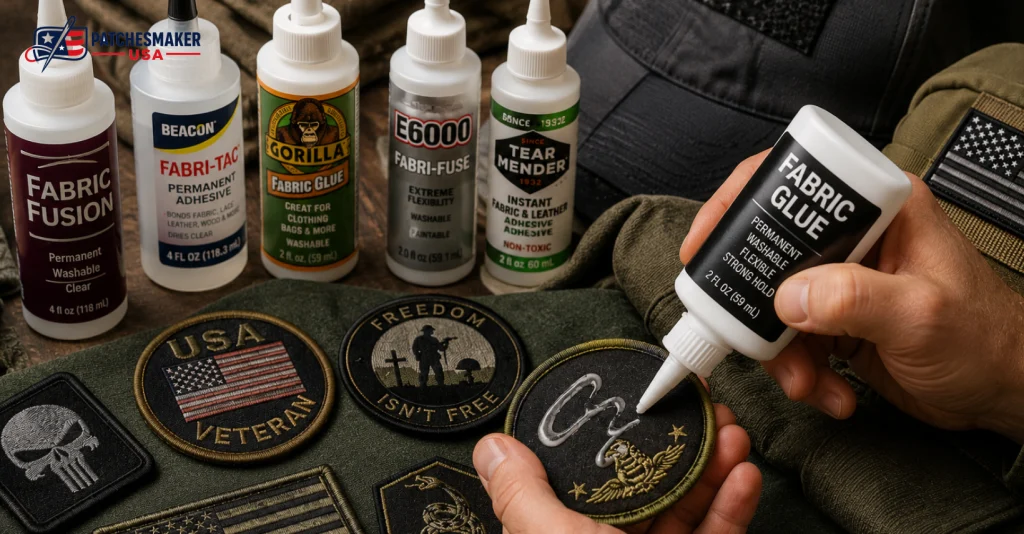
When searching for the best fabric glue for patches, you’ll find dozens of products claiming to offer a permanent hold. However, only a handful consistently perform well on clothing, bags, uniforms, and outdoor gear.
Aleene’s Fabric Fusion
Aleene’s remains one of the most trusted names in fabric adhesives. Its Fabric Fusion formula dries clear, remains flexible after curing, and is designed to withstand regular washing.
Best for:
- Custom Embroidered Patches
- Cotton garments
- Hoodies
- T-shirts
- Tote bags
Many crafters and small businesses favour Aleene’s because it provides a professional-looking finish without stiffening the fabric.
Beacon Fabri-Tac
Beacon Fabri-Tac is often considered a professional-grade fabric adhesive.
Its fast-grab formula allows patches to stay in place quickly while maintaining flexibility after curing.
Best for:
- Uniforms
- Jackets
- Promotional apparel
- Custom Logo Patches
This adhesive is particularly useful when accurate patch placement is essential.
Gorilla Fabric Glue
Gorilla’s fabric glue is designed for demanding environments.
It provides excellent resistance to moisture, heat, and everyday wear.
Best for:
- Outdoor apparel
- Sports bags
- Workwear
- Utility gear
For customers attaching Custom PVC Patches to rugged equipment, Gorilla Fabric Glue can be a strong choice.
Tear Mender
Tear Mender has been trusted for decades due to its natural latex-based formula.
Unlike some synthetic adhesives, it creates a flexible and breathable bond.
Best for:
- Denim jackets
- Canvas bags
- Cotton uniforms
- Leather accessories
The natural flexibility makes it ideal for clothing that experiences frequent movement.
E6000 Fabri-Fuse
E6000 is famous for creating extremely durable bonds.
It is commonly used for attaching heavy patches and decorative embellishments.
Best for:
- Thick jackets
- Heavy-duty uniforms
- Rubber-backed patches
- PVC patches
When durability is the top priority, E6000 is often the go-to solution.
Choosing the Right Adhesive for Different Fabrics
Not all fabrics respond to adhesives in the same way. Understanding fabric behaviour can significantly improve patch longevity.
Cotton
Cotton is one of the easiest materials to work with.
Recommended adhesive:
- Standard fabric glue
- Custom Embroidered Patches
- Name Patches
- School Patches
Preparation:
- Wash first
- Remove lint
- Iron flat before application
Denim
Denim provides excellent grip for adhesives due to its textured surface.
Recommended adhesive:
- Fabric glue
- Flexible contact adhesive
Best patch types:
- Motorcycle Club Patches
- Military Patches
- Fashion patches
Preparation:
- Lightly clean the surface
- Apply firm pressure during curing
Canvas
Canvas works well with most fabric adhesives.
Recommended adhesive:
- Fabric glue
- Contact adhesive
Best patch types:
- Custom Logo Patches
- Promotional patches
- Outdoor gear patches
Canvas is commonly used for backpacks and tote bags, making proper adhesion especially important.
Nylon
Nylon can be challenging because many versions include water-resistant coatings.
Recommended adhesive:
- Fabric-safe specialty adhesive
- Hook-and-loop systems
Best patch types:
- Custom Velcro Patches
- Tactical patches
- Backpack patches
Always test on a hidden area before full application.
Leather
Leather requires extra caution.
Recommended adhesive:
- Specialty leather adhesive
- Sewing for permanent applications
Best patch types:
- Motorcycle Patches
- Club Patches
- Custom Leather Patches
Excess adhesive can stain leather permanently, so careful application is essential.
Why Custom Velcro Patches Continue to Grow in Popularity
Many organizations are moving away from permanent patch installation and choosing hook-and-loop systems instead.
Custom Velcro Patches offer flexibility that traditional sewn-on patches cannot match.
Benefits include:
- Easy replacement
- Swappable branding
- Simplified cleaning
- Multiple designs on one garment
Industries commonly using velcro patches include:
- Military
- Law enforcement
- Security services
- Emergency response teams
- Outdoor recreation brands
At Patches Maker USA, Custom Velcro Patches remain one of our fastest-growing product categories due to their versatility and professional appearance.
How to Apply Fabric Glue to Patches Correctly
Even the best adhesive can fail if applied incorrectly.
Follow this proven process for maximum durability.
Step 1: Clean the Surface
Remove:
- Dust
- Oils
- Lint
- Dirt
Contaminants reduce adhesive performance significantly.
Step 2: Prepare the Fabric
Lay the garment flat and remove wrinkles.
A smooth surface ensures even contact between the patch and fabric.
Step 3: Position the Patch
Use:
- Fabric chalk
- Painter’s tape
- Measuring tools
Accurate positioning prevents costly mistakes.
This is especially important when applying Custom Logo Patches to uniforms and branded apparel.
Step 4: Apply a Thin Layer of Adhesive
More glue does not mean a stronger bond.
Instead:
- Apply a thin, even layer
- Focus on edges
- Avoid oversaturation
Excess glue can seep through fabrics and create visible staining.
Step 5: Press Firmly
Apply pressure for 30 to 60 seconds.
Ensure every edge makes full contact with the garment.
Step 6: Weight the Patch
Place a flat object over the patch while curing.
Examples:
- Books
- Wooden boards
- Fabric-covered weights
This prevents lifting during the curing process.
Step 7: Allow Full Cure Time
Most adhesive failures occur because users rush this step.
Follow manufacturer recommendations carefully.
Many adhesives require:
- 24 hours minimum
- 48 to 72 hours for full strength
Avoid washing or wearing the item prematurely.
Common Patch Adhesive Mistakes to Avoid
Using General Craft Glue
Craft glue is not designed for textile movement or laundering.
Always choose adhesives specifically formulated for fabric.
Applying Too Much Adhesive
Excess glue often causes:
- Stiff fabric
- Visible residue
- Uneven bonding
Thin layers consistently perform better.
Ignoring Cure Time
This remains the most common mistake.
A patch may appear secure but still require additional curing time.
Skipping Surface Preparation
Dust and oils weaken adhesion.
Cleaning takes only minutes but dramatically improves results.
Forgetting Edge Pressure
Patch corners experience the most stress.
Proper pressure helps prevent premature lifting.
Why Quality Patches Matter Just as Much as Quality Glue
Even the strongest adhesive cannot compensate for poor-quality patches.
Low-quality patches may:
- Curl
- Fray
- Separate from backing materials
This is why businesses, clubs, and organisations choose professionally manufactured products.
Popular options from Patches Maker USA include:
Custom Embroidered Patches
Ideal for:
- Uniforms
- Corporate branding
- Sports teams
- Schools
Custom PVC Patches
Perfect for:
- Tactical gear
- Outdoor brands
- Military applications
Military Patches
Built for:
- Veterans
- Active service members
- Collectors
- Tactical organisations
Motorcycle Club Patches
Designed to withstand:
- Outdoor conditions
- Frequent wear
- Long-distance riding
Custom Name Patches
Excellent for:
- Work uniforms
- Security personnel
- Service industries
Custom Logo Patches
Perfect for:
- Brand promotion
- Employee uniforms
- Events
- Merchandise
Internal Resources You May Find Helpful
If you’re exploring patch application methods, these related guides may also help:
- How to Add Velcro to a Patch Using the Easiest Methods & Best Glues
- How to Remove Patch Glue from Different Fabrics
- Custom Velcro Patches Buying Guide
- Embroidered vs PVC Patches: Which Is Right for You?
- Best Backing Options for Custom Patches
- How to Design Custom Logo Patches for Your Business
These resources help customers choose the right patch and attachment method for their specific application.
Frequently Asked Questions
What Is the Best Fabric Glue for Patches on Clothing?
A flexible, washable fabric adhesive such as Aleene’s Fabric Fusion or Beacon Fabri-Tac is often considered the best option for clothing applications.
Can Fabric Glue Replace Sewing?
In many cases, yes. High-quality fabric adhesives can provide excellent durability when used correctly. However, sewing remains preferable for extremely demanding applications.
How Long Should Fabric Glue Cure?
Most fabric adhesives require at least 24 hours. Some products may need up to 72 hours for maximum strength.
Can You Glue Patches to Backpacks?
Yes. Fabric glue works well on canvas backpacks, while hook-and-loop systems are often better for nylon backpacks.
What Is the Best Adhesive for Custom Velcro Patches?
Flexible fabric-safe adhesives designed for hook-and-loop bonding provide the best long-term performance.
Can Fabric Glue Damage Clothing?
When used correctly, fabric glue should not damage clothing. Always follow manufacturer instructions and test unfamiliar fabrics first.
Are PVC Patches Suitable for Glue Application?
Yes. Custom PVC Patches can be attached using strong flexible adhesives, particularly on bags, gear, and outdoor equipment.
Do Glued Patches Survive Washing?
Quality adhesives designed for fabric can survive regular washing when properly applied and fully cured.
Final Thoughts
Choosing the best fabric glue for patches is about more than convenience. The right adhesive protects your investment, improves durability, and ensures your patches maintain a professional appearance over time.
Whether you’re applying Custom Embroidered Patches to uniforms, Custom Logo Patches to promotional merchandise, Military Patches to tactical gear, or Custom Velcro Patches to outdoor equipment, selecting the proper adhesive and installation method is critical.
At Patches Maker USA, we offer premium-quality custom patches designed for durability, performance, and professional presentation. Combined with the right attachment method, your patches can continue looking great through years of wear and use.