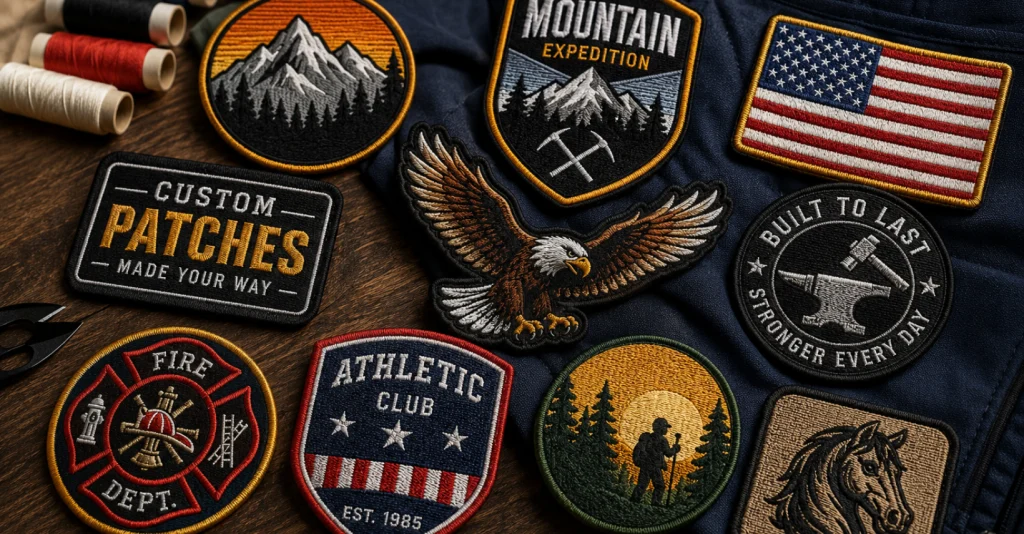
Custom embroidered patches have remained a popular choice for businesses, organizations, schools, sports teams, clubs, brands, and individuals who want a unique way to showcase identity. Unlike ordinary printed graphics, embroidered patches add texture, dimension, and a handcrafted appearance to clothing and accessories. They can transform a simple jacket into a statement piece, give a uniform a professional appearance, or turn a brand logo into a wearable promotional tool.
Whether you need custom patches for your business uniforms, motorcycle club, sports team, school, fashion collection, event, or personal project, understanding the patch-making process can help you make better decisions. From choosing the right artwork and patch size to selecting a suitable backing and border, every detail can influence the appearance and performance of your finished patches.
At Patches Maker USA, we understand that every patch represents something meaningful. It may represent a company, a community, an achievement, a team, a personal passion, or a memorable event. That is why our goal is to help customers turn their ideas into high-quality custom patches that look professional and are built to last.
This complete guide explores everything you need to know about custom embroidered patches, including how they are made, how to prepare your artwork, which backing option is right for you, where patches can be used, and how to order custom patches with confidence.
What Are Custom Embroidered Patches?
Custom embroidered patches are decorative fabric badges created by stitching thread onto a base material to reproduce a logo, name, symbol, illustration, or custom design. The embroidery creates a raised, textured surface that gives the patch a distinctive three-dimensional appearance.
Unlike direct embroidery, where a design is stitched directly onto a garment, an embroidered patch is produced separately and then attached to a jacket, shirt, hat, uniform, backpack, bag, vest, or another suitable surface.
This flexibility is one of the biggest reasons embroidered patches are so popular. A single patch design can be created in bulk and then applied to different products or garments. If you want to change the appearance of a jacket or uniform, you can often replace or reposition patches without having to redesign the entire garment.
Custom embroidered patches can be created in virtually any shape. Popular options include:
- Round patches
- Square patches
- Rectangle patches
- Oval patches
- Shield patches
- Diamond patches
- Custom-shaped patches
- Letter patches
- Logo patches
- Name patches
- Number patches
- Character patches
The final design can include different thread colors, lettering, symbols, borders, and other visual elements. With professional digitization and careful production, even a simple concept can become a visually impressive patch.
How Are Custom Embroidered Patches Made?
Creating a quality embroidered patch involves more than simply stitching a logo onto fabric. Several stages are involved, and each step plays an important role in determining the quality of the final product.
1. Artwork Submission
The process usually starts when you provide your artwork or design concept. Your artwork may be a professional vector logo, a digital image, a sketch, or even a rough idea of what you want.
High-resolution artwork is generally helpful because it allows the production team to understand the details of your design more accurately. However, you do not necessarily need to be a professional designer to order custom patches.
If you only have a basic concept, a professional patch maker can often help you determine how to adapt the design for embroidery.
2. Artwork Review
Before production begins, your artwork should be reviewed for embroidery compatibility.
Some design elements that look perfect on a computer screen may not translate well into stitches. Extremely thin lines, tiny lettering, complex details, and subtle color transitions can be difficult to reproduce accurately at a small size.
A proper artwork review identifies these potential problems before production begins. Adjustments can then be made to improve readability and visual impact.
3. Digitization
Digitization is one of the most important steps in the embroidery process.
During digitization, your artwork is converted into a specialized embroidery file that tells the embroidery machine how to create the design. The digitizer determines stitch types, stitch direction, density, thread paths, colors, and other technical details.
Professional digitization can make a significant difference in the final appearance of your patch.
A poorly digitized design may result in:
- Uneven stitching
- Excessive thread buildup
- Gaps in the design
- Poorly defined lettering
- Distorted shapes
- Weak borders
- Unnecessary thread density
A well-digitized design, on the other hand, can produce clean lettering, balanced stitching, sharp borders, and a more professional overall appearance.
4. Choosing the Base Material
The embroidered design is typically stitched onto a fabric base. Twill is one of the most common materials used for embroidered patches because it provides a smooth, stable surface for stitching.
Depending on the desired appearance and application, different materials may be considered. The base fabric can influence the patch’s texture, durability, and overall style.
5. Embroidery
Once the design has been digitized and prepared, embroidery machines stitch the design onto the selected fabric.
The machine follows the digitized instructions to reproduce the artwork using colored embroidery threads. Different stitch patterns can be used to create different visual effects.
The embroidery process can include:
- Satin stitches
- Fill stitches
- Running stitches
- Detailed border stitching
- Layered thread patterns
The combination of these techniques gives embroidered patches their distinctive texture and depth.
6. Cutting the Patch
After embroidery is completed, the patch is cut into its final shape. Depending on the design, the patch may have a traditional geometric shape or a custom shape that follows the outline of the artwork.
Custom-shaped patches are especially popular when the design itself has a unique silhouette.
7. Adding the Border
The border provides both visual definition and structural support.
A clean merrowed or embroidered border can give the patch a finished appearance while helping prevent the edges from fraying. Border color can be selected to complement or contrast with the main design.
For some designs, a contrasting border helps the patch stand out. For others, a matching border creates a cleaner and more understated appearance.
8. Applying the Backing
The final stage involves adding the selected backing option.
The backing determines how the patch will be attached to the intended surface. Different applications require different backing types, so this is an important decision to make before ordering.
Why Choose Custom Embroidered Patches?
There are many ways to decorate clothing and accessories, but embroidered patches continue to be one of the most popular options.
Here are some of the reasons customers choose them.
Long-Lasting Appearance
Quality embroidered patches are designed to withstand regular use. When properly attached and cared for, they can remain on garments and accessories for a long time.
The thread-based construction gives embroidered patches an advantage over many surface-printing methods when durability is a priority.
Professional Look
Embroidery has a traditional, premium appearance. The texture of the thread adds dimension to logos and artwork, helping even a simple design stand out.
This makes embroidered patches particularly useful for companies that want their employees to present a consistent and professional image.
Strong Brand Recognition
A logo patch can turn ordinary apparel into branded merchandise.
Employees can wear branded uniforms, customers can purchase promotional jackets, and event participants can receive commemorative patches. Every time someone wears the patch, the design has an opportunity to be seen by others.
Flexible Applications
Custom patches can be used on many different products.
You can attach them to:
- Jackets
- Hats
- Caps
- Shirts
- Uniforms
- Vests
- Backpacks
- Tote bags
- Travel bags
- Workwear
- Sports apparel
This flexibility makes patches useful for both personal and commercial projects.
A Sense of Identity
Patches are not only decorative. They can represent belonging.
A school patch can represent achievement. A sports patch can represent team membership. A company patch can represent professional identity. A club patch can represent shared interests and community.
This emotional connection is one of the reasons patches continue to be relevant in fashion, uniforms, promotional merchandise, and group apparel.
How to Create a Great Embroidered Patch Design
A successful patch begins with a good design. However, creating a design for embroidery requires a different approach from creating artwork for a website or printed advertisement.
Keep the Design Clear
The best embroidered patches are often easy to recognize at a glance.
Avoid overcrowding the design with unnecessary elements. If your patch includes a logo, text, and additional graphics, make sure each component has enough space to remain visible.
A clean design is usually easier to embroider and easier for people to understand.
Consider the Patch Size
Size has a major impact on the level of detail you can include.
A large back patch may accommodate detailed artwork and longer text. A small hat patch may require a simplified version of the same design.
Before finalizing your artwork, consider where the patch will be used.
A design that works beautifully as a six-inch jacket patch may need to be simplified if you want to use it as a two-inch hat patch.
Choose Readable Fonts
Typography can be challenging in embroidery.
Very small letters may become difficult to read once converted into stitches. Decorative fonts can also lose clarity if the design is too small.
For names, slogans, and logos, choose lettering that remains recognizable at the intended patch size.
Use Strong Color Contrast
Contrast helps important elements stand out.
For example, light-colored lettering on a dark background may be easier to read than two similar shades. Your border should also provide enough contrast to define the shape of the patch.
A professional patch maker can help you select thread colors that produce a balanced final result.
Avoid Excessive Detail
Embroidery has physical limitations. Tiny lines and extremely intricate details may not reproduce exactly as they appear in digital artwork.
This does not mean your design needs to be boring. It simply means that complex artwork may need to be simplified or adjusted.
The goal is to preserve the personality and meaning of your design while making sure it works effectively as an embroidered patch.
Embroidered Patch Size: What Should You Choose?
There is no single perfect patch size.
The right size depends on the application, design, and available space.
Small Patches
Small patches are suitable for:
- Hats
- Shirt sleeves
- Small bags
- Children’s clothing
- Compact logos
- Minimal designs
Because space is limited, small patches typically work best with simple designs.
Medium Patches
Medium-sized patches are versatile and can be used on:
- Jackets
- Uniforms
- Backpacks
- Workwear
- Sports apparel
- Club clothing
This size provides enough room for logos, symbols, and moderate amounts of text.
Large Patches
Large patches are often selected for:
- Jacket backs
- Motorcycle vests
- Large bags
- Fashion pieces
- Statement apparel
The larger surface allows more room for detailed artwork and larger lettering.
When ordering, it is always helpful to measure the area where the patch will be placed. This can prevent surprises when the finished patch arrives.
Custom Patch Backing Options
Choosing the correct backing is just as important as choosing the design.
Different backing types offer different advantages depending on how often you plan to use the patch and whether you want it to be permanent or removable.
Sew-On Patches
Sew-on backing is one of the most secure options.
The patch is attached directly to the garment or accessory using thread. This method is especially useful for applications that experience regular movement, friction, or washing.
Sew-on patches are commonly used for:
- Work uniforms
- Motorcycle vests
- Heavy jackets
- Outdoor clothing
- Sports bags
- Long-term applications
If durability is your primary concern, sewing is often an excellent choice.
Iron-On Patches
Iron-on patches feature a heat-activated adhesive backing.
When exposed to the correct temperature and pressure, the adhesive bonds with the fabric. This makes iron-on patches convenient for many apparel applications.
They are popular for:
- Casual jackets
- Shirts
- School projects
- Fashion garments
- DIY clothing customization
However, not every fabric is suitable for iron-on application. Delicate, heat-sensitive, waterproof, or heavily textured materials may require another attachment method.
For maximum durability, some customers choose to sew around an iron-on patch after applying it.
Velcro-Backed Patches
Velcro patches are designed for situations where the patch needs to be removed, replaced, or exchanged.
They are commonly associated with tactical apparel, uniforms, bags, and morale patches.
The advantage is flexibility. You can create several patches and switch them depending on the occasion or activity.
Velcro-backed patches can be especially useful for organizations that need interchangeable identification or branding.
Adhesive Backing
Adhesive-backed patches are designed for temporary or short-term applications.
They can be useful for events, promotional campaigns, giveaways, or situations where you do not want to permanently attach the patch.
The exact performance of adhesive backing depends on the surface and environmental conditions.
Common Uses for Custom Embroidered Patches
One of the best things about custom patches is their versatility.
Business and Corporate Branding
Businesses can use embroidered patches to create branded uniforms and workwear.
A company logo stitched onto a jacket, shirt, or cap can create a consistent appearance across a team.
Patches can also be used as promotional merchandise. Branded patches can be distributed at trade shows, events, conferences, and community activities.
Work Uniforms
Many industries use patches as part of their uniforms.
Construction companies, landscaping businesses, hospitality teams, security services, transportation companies, and other organizations can use patches to display company names, employee roles, or department information.
Because workwear is often exposed to demanding conditions, durability is an important consideration.
Sports Teams
Custom patches are popular across sports at every level.
Teams can use patches for:
- Jerseys
- Jackets
- Hats
- Equipment bags
- Championship apparel
- Tournament merchandise
A team logo can create a strong visual identity and help players and supporters feel connected.
Championship and commemorative patches can also mark important achievements.
Schools and Universities
Schools can use embroidered patches for uniforms, clubs, academic achievements, sports programs, and special events.
A school logo or mascot patch can become a recognizable symbol of community and pride.
Motorcycle Clubs
Motorcycle patches have a long history of representing identity and community.
Large back patches, smaller chest patches, name patches, and rocker-style designs can be used to create distinctive club apparel.
For motorcycle applications, durability is particularly important because jackets and vests are exposed to outdoor conditions and frequent use.
Fashion and Streetwear
Fashion designers and independent clothing brands have embraced patches as a creative design element.
A custom embroidered patch can add texture and personality to:
- Denim jackets
- Bomber jackets
- Hoodies
- Caps
- Jeans
- Bags
Patches can be used as subtle branding or as a bold visual statement.
Limited-edition patches can also become collectible merchandise for fashion brands.
Events and Organizations
Custom patches make memorable event merchandise.
They can be designed for:
- Conferences
- Festivals
- Charity events
- Fundraisers
- Community groups
- Annual gatherings
- Special celebrations
A commemorative patch can serve as a long-lasting reminder of an event.
Personal Projects
You do not need to represent a large organization to order custom patches.
Individuals can create patches based on hobbies, artwork, personal interests, travel memories, or creative projects.
Custom patches can make ordinary clothing and accessories feel more personal.
How to Order Custom Embroidered Patches
Ordering custom patches should be a simple and straightforward experience.
At Patches Maker USA, the process begins with your idea.
Step 1: Prepare Your Artwork
Send us your logo, image, sketch, or design concept.
If you already have professional artwork, that is ideal. If your design needs adjustments for embroidery, our team can help identify potential issues.
Step 2: Select Your Patch Details
Consider the following:
- Patch size
- Shape
- Thread colors
- Border style
- Backing type
- Quantity
- Intended application
Having these details ready can make the ordering process easier.
Step 3: Review the Design
Before production, review your digital proof or mockup carefully.
Pay attention to:
- Text spelling
- Logo proportions
- Colors
- Patch dimensions
- Border
- Overall layout
This is the best opportunity to request changes before production begins.
Step 4: Approve Your Patch
Once you are happy with the design, production can begin.
The artwork is digitized and prepared for embroidery according to the approved specifications.
Step 5: Production
Your patches are embroidered, finished, cut, bordered, and prepared with the selected backing.
Quality control is important throughout this stage to ensure the final patches match the approved design.
Step 6: Delivery
Once production is complete, your custom patches are prepared for shipment.
When your order arrives, inspect the patches and confirm that the size, colors, design, and quantity meet your expectations.
What Should You Ask a Custom Patch Maker?
Before placing an order, it is worth asking a few important questions.
Do You Provide Artwork Assistance?
If you are unsure whether your artwork will work for embroidery, ask whether the company provides artwork review or design assistance.
Is Digitization Included?
Some companies charge additional fees for digitization, while others may include it as part of their service.
Make sure you understand what is included in the quoted price.
What Backing Options Are Available?
Not every patch maker offers every backing type. Confirm that the backing you need is available before placing your order.
Can I See a Digital Proof?
A digital proof allows you to review the design before production. This can help catch mistakes and ensure that your expectations are aligned with the final product.
What Is the Production Timeline?
Ask about the expected turnaround time before ordering, especially if you need patches for a specific event or deadline.
Rush production may be available for urgent projects, depending on the manufacturer and order requirements.
Is There a Minimum Order Quantity?
Minimum quantities vary between patch manufacturers.
If you need only a small number of patches, look for a company that can accommodate smaller orders.
How Much Do Custom Embroidered Patches Cost?
The cost of custom embroidered patches can vary depending on several factors.
These may include:
- Patch size
- Number of colors
- Design complexity
- Stitch count
- Backing type
- Quantity ordered
- Border style
- Special finishing requirements
In general, larger and more detailed patches require more materials and production time.
Ordering larger quantities may also reduce the per-unit cost, making bulk orders attractive for businesses, teams, schools, and organizations.
Instead of choosing a supplier based solely on the lowest price, consider the overall value. A low-cost patch that has poor stitching, weak borders, or inaccurate colors may not deliver the professional appearance you need.
A reliable patch maker should provide clear pricing and explain any additional costs before production begins.
Embroidered Patches vs. Printed Patches
Both embroidered and printed patches have their advantages, but they create very different visual effects.
Embroidered Patches
Embroidered patches are ideal when you want:
- Texture
- Dimension
- A traditional appearance
- Strong visual impact
- A premium feel
- Durable thread-based decoration
They work especially well for logos, uniforms, jackets, caps, and club apparel.
Printed Patches
Printed patches are often better suited to artwork that contains:
- Photographic images
- Complex gradients
- Very detailed illustrations
- Extensive color variations
Because the artwork is printed rather than stitched, extremely detailed images can often be reproduced more easily.
The right option depends on your artwork and intended use.
If you want the classic, textured appearance associated with traditional patches, embroidered patches are an excellent choice.
How to Care for Custom Embroidered Patches
Proper care can help your patches maintain their appearance for longer.
Always follow the care instructions appropriate for the garment and attachment method.
For garments with embroidered patches, consider:
- Washing according to the manufacturer’s instructions
- Avoiding unnecessarily harsh detergents
- Turning garments inside out when appropriate
- Avoiding excessive heat
- Allowing garments to dry according to fabric recommendations
Iron-on patches may require additional care because repeated high-temperature washing or drying can affect the adhesive over time.
If a patch begins to lift at the edges, reinforcing it with stitching can help extend its lifespan.
Common Mistakes to Avoid When Ordering Patches
Choosing the Wrong Size
A patch that is too small may make text unreadable, while an oversized patch may not fit the intended garment.
Always measure the application area before finalizing your order.
Using Too Much Detail
Complex artwork may need to be simplified for embroidery.
Work with your patch maker to determine which elements should remain and which can be adjusted.
Ignoring the Backing
The wrong backing can cause unnecessary problems.
Think about whether you want a permanent, removable, temporary, or heat-applied solution.
Not Reviewing the Proof
Always check your design proof carefully.
A small spelling mistake or incorrect color is much easier to fix before production than after the patches have been manufactured.
Focusing Only on Price
The cheapest option is not always the best value.
Quality digitization, thread selection, accurate stitching, clean borders, and reliable finishing all contribute to the final result.
Why Choose Patches Maker USA?
At Patches Maker USA, we believe custom patches should combine creativity, quality, and dependable craftsmanship.
Our goal is to make the custom patch process straightforward, whether you are ordering your first patch or managing a large production project.
We work with customers who need patches for:
- Businesses
- Corporate uniforms
- Schools
- Universities
- Sports teams
- Clubs
- Motorcycle groups
- Fashion brands
- Events
- Organizations
- Personal projects
We understand that every customer has different requirements. A business may need a clean logo patch for employee uniforms, while a fashion designer may want an intricate statement piece. A sports team may need commemorative patches, while an individual may want a one-of-a-kind design.
Our approach is centered on helping you create a patch that fits your purpose.
From artwork preparation and design review to embroidery and finishing, every stage matters.
Custom Patches for Businesses Across the USA
Businesses throughout the United States use custom patches to create recognizable branding and professional uniforms.
Whether your company operates in New York, California, Texas, Florida, Illinois, Pennsylvania, Ohio, Georgia, Michigan, North Carolina, New Jersey, Virginia, Washington, Arizona, Tennessee, Massachusetts, Indiana, Missouri, Maryland, Wisconsin, Colorado, Minnesota, South Carolina, Alabama, Louisiana, Kentucky, Oregon, Oklahoma, Connecticut, Utah, Nevada, Arkansas, Mississippi, Kansas, New Mexico, Nebraska, Idaho, West Virginia, Hawaii, New Hampshire, Maine, Montana, Rhode Island, Delaware, South Dakota, North Dakota, Alaska, Vermont, Wyoming, or elsewhere in the country, custom embroidered patches can help you create a consistent and professional visual identity.
A well-designed patch can become an important part of your brand’s apparel strategy.
It can appear on employee uniforms, promotional clothing, company jackets, work shirts, hats, bags, and other merchandise.
For small businesses, custom patches can also be an affordable way to create branded apparel without ordering completely customized garments.
Frequently Asked Questions About Custom Embroidered Patches
Are embroidered patches durable?
Yes. High-quality embroidered patches can be highly durable when properly produced and attached. Their lifespan depends on factors such as thread quality, backing method, garment material, frequency of use, and care.
Can I turn my logo into an embroidered patch?
Absolutely. Logos are among the most common designs used for embroidered patches. Depending on the complexity of the artwork, some adjustments may be recommended to ensure the design translates effectively into embroidery.
Can embroidered patches be made in custom shapes?
Yes. Custom-shaped patches can be produced to match the outline or concept of your design.
Are custom patches suitable for hats?
Yes. Small embroidered patches can be an excellent way to customize hats and caps. The design should be sized appropriately for the available surface area.
Can I order patches for a small business?
Yes. Custom patches can be useful for businesses of all sizes. Small businesses can use them for employee uniforms, branded merchandise, promotional giveaways, and customer apparel.
Can patches be removed?
The ability to remove a patch depends on the backing and attachment method. Sew-on patches can generally be removed by carefully cutting the stitches, while iron-on patches may be more difficult to remove without affecting the fabric.
How long does it take to make custom patches?
Production time varies depending on design complexity, quantity, backing type, and current production schedules. Always confirm the expected turnaround time when placing your order, especially if you have an upcoming deadline.
Can I order custom patches for an event?
Yes. Custom patches are popular for conferences, festivals, sports tournaments, fundraisers, reunions, and other events. They can serve as memorable keepsakes or promotional merchandise.
What artwork should I submit?
High-resolution artwork is generally preferred. Vector files are often ideal, but many patch makers can work with common image formats as well. If you only have a rough sketch or concept, ask whether artwork assistance is available.
Are embroidered patches better than direct embroidery?
Neither option is universally better. Direct embroidery is ideal when you want the design stitched directly onto a garment, while patches offer more flexibility because they can be produced separately and attached to different products.
Final Thoughts: Bring Your Patch Idea to Life
Custom embroidered patches are more than decorative accessories. They are a practical and creative way to showcase identity, build brand recognition, celebrate achievements, and bring people together.
Whether you are creating a company logo patch, designing uniforms for a sports team, producing merchandise for a fashion brand, or simply turning your personal artwork into something wearable, the right patch can make a lasting impression.
The key is to start with a design that works well for embroidery, choose the right size and backing, and work with a patch maker that understands the importance of quality and attention to detail.
At Patches Maker USA, we are here to help you transform your ideas into custom patches that represent your vision. From the first artwork review to the final embroidered product, our goal is to make the process simple and deliver patches you will be proud to wear, share, and use.
Ready to create your own custom embroidered patches? Start with your design, choose the details that fit your needs, and let Patches Maker USA help bring your idea to life with custom patches made for your brand, team, organization, or personal project.