Building a recognisable brand is one of the biggest challenges for small businesses in the United States. Whether you own a clothing brand, manage a local business, run a sports team, or operate an independent fashion label, creating a strong visual identity is essential for attracting customers and building long-term recognition. While digital marketing, social media, and traditional advertising all play important roles, customised products can also help businesses establish a memorable identity.
One increasingly popular branding solution is custom patches. These small but powerful branding accessories allow businesses to display their logos, names, slogans, and creative artwork on clothing, uniforms, bags, hats, jackets, and promotional merchandise. They offer a practical way to turn everyday products into branded items without requiring businesses to invest in completely customised garments.
However, finding the best custom patch maker for small businesses in USA requires more than simply comparing prices. Business owners need a reliable manufacturer that understands their branding requirements, offers different patch styles, maintains consistent quality, and provides flexible ordering options.
At Patches Maker USA, businesses can explore customised patch solutions designed to support their branding, promotional, fashion, and identification needs. This guide explains how to choose the right custom patch manufacturer, which patch styles are worth considering, and how small businesses can use personalised patches to strengthen their brand identity.
Why Custom Patches Are Valuable for Small Businesses
Small businesses often operate with limited marketing budgets. Unlike larger companies, they may not have the resources to run expensive advertising campaigns or launch extensive promotional activities. This makes affordable and reusable branding solutions especially important.
Custom patches provide an opportunity to display a business identity across different products and materials. Instead of printing a logo separately on every item, companies can use patches to create a consistent appearance across their merchandise.
Here are some important reasons why custom patches are valuable for growing businesses.
1. Create a Recognisable Brand Identity
Brand recognition develops when customers repeatedly see the same logo, colours, and design elements. Custom patches help businesses maintain this consistency across different products.
For example, a small clothing brand can use the same embroidered logo patch on jackets, hoodies, caps, and backpacks. This creates a unified appearance and makes the brand easier to recognise.
Restaurants, construction companies, fitness studios, and retail businesses can also use customised patches on employee uniforms to maintain a professional visual identity.
2. Affordable Branding for Growing Companies
Budget management is important for small businesses. Every marketing investment should provide practical value.
Custom patches can be ordered separately and attached to different garments or accessories. This allows business owners to purchase blank products and customise them according to their branding requirements.
Depending on the patch type and application method, businesses may also be able to reuse patches on replacement garments or different products.
3. Professional Appearance for Employees
A consistent employee uniform helps customers identify staff members quickly. Custom logo patches make uniforms look more organised and professional.
For example, a cleaning company can add branded patches to work shirts, while a security business can use identification patches on jackets and uniforms.
The same approach works for restaurants, delivery services, repair companies, and hospitality businesses.
4. More Opportunities for Merchandise Sales
Small clothing businesses can use custom patches to expand their product collections without designing completely new garments.
A brand can create limited-edition patches featuring seasonal artwork, special logos, creative illustrations, or exclusive messages.
Customers can attach these patches to denim jackets, jeans, hats, tote bags, and backpacks. This creates additional merchandise opportunities while giving customers more freedom to personalise their belongings.
5. Long-Lasting Promotional Products
Traditional advertising materials are often temporary. Custom patches, however, can remain attached to clothing and accessories for extended periods when manufactured and applied correctly.
A well-designed patch can continue displaying a company’s logo wherever the product is worn or used.
This makes personalised patches an interesting option for promotional campaigns, brand merchandise, community events, and customer giveaways.
What Makes the Best Custom Patch Maker in the USA?
Not every patch manufacturer offers the same level of service, production quality, or customisation. Choosing the right supplier can make a significant difference to the final product.
Before placing an order, small business owners should consider several important factors.
1. Wide Range of Custom Patch Styles
A reliable custom patch maker should offer multiple patch options because different businesses have different branding requirements.
Some companies prefer traditional embroidered patches, while others need detailed woven artwork or modern PVC designs.
Look for a manufacturer offering options such as:
- Embroidered patches
- Woven patches
- PVC patches
- Printed patches
- Chenille patches
- Leather patches
- Iron-on patches
- Velcro patches
- Custom logo patches
Having access to different materials and manufacturing techniques makes it easier to select a patch that matches your products and brand identity.
2. Consistent Manufacturing Quality
Quality should always be a priority when choosing a custom patch manufacturer.
Poor stitching, uneven borders, incorrect colours, and unclear artwork can affect the overall appearance of a patch. These problems may also create an unprofessional impression when patches are used on uniforms or products for sale.
Before ordering, ask about material options, stitching quality, backing methods, finishing details, and artwork requirements.
A professional supplier should understand how to translate your digital design into a finished patch while maintaining the important details of your artwork.
3. Flexible Ordering Options
Small businesses do not always need thousands of patches. A startup clothing brand may only require a small quantity for its first product collection.
Look for a supplier that can explain its minimum order quantities, pricing structure, and available production options.
Flexible ordering can help new businesses test different designs before committing to larger production runs.
4. Custom Shapes and Sizes
Your patch should reflect your brand rather than forcing your artwork into a standard shape.
For example, a clothing company may want a circular logo patch, while a motorcycle business might prefer a custom-shaped emblem.
A good custom patch maker should provide different shape and size possibilities, including:
- Round patches
- Square patches
- Rectangular patches
- Shield-shaped patches
- Oval patches
- Custom die-cut patches
The right shape can help your logo stand out while maintaining a professional appearance.
5. Clear Communication and Customer Support
Communication is an important part of custom manufacturing.
Business owners should be able to discuss their artwork, dimensions, colours, backing requirements, and production expectations before confirming an order.
A reliable supplier should make the ordering process understandable and help customers identify suitable options for their requirements.
Different Types of Custom Patches for Small Businesses
Understanding the available patch styles is one of the most important steps when planning your branding strategy.
Each patch type offers different visual characteristics, making some options more suitable for particular industries and products.
1. Embroidered Patches
Embroidered patches are among the most popular choices for business branding.
They are created by stitching coloured threads onto a fabric base to produce logos, lettering, symbols, and decorative designs.
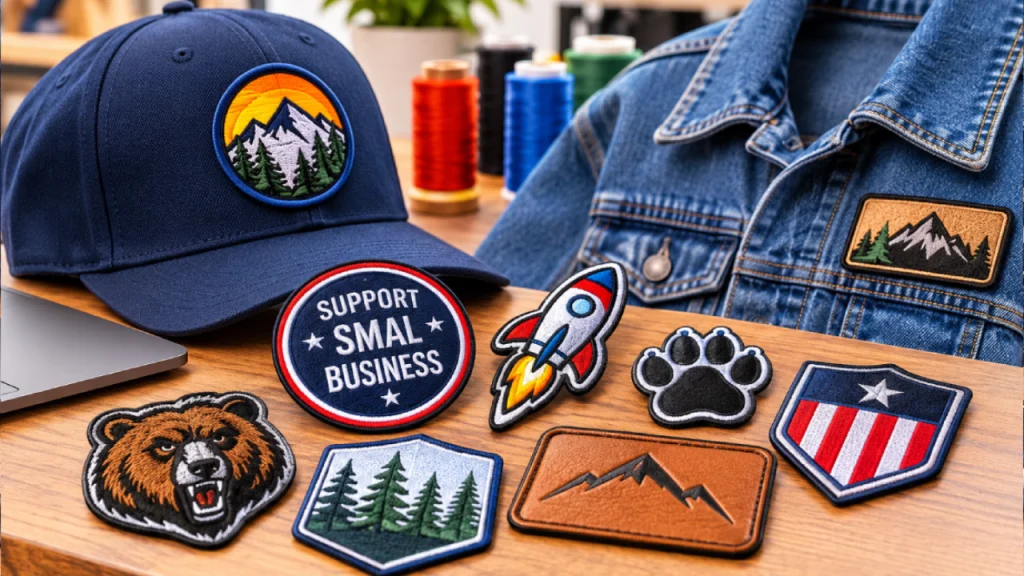
The raised thread texture gives embroidered patches a traditional appearance that works particularly well for clothing brands, workwear, uniforms, sports teams, and promotional merchandise.
Best uses:
- Company uniforms
- Baseball caps
- Denim jackets
- Hoodies
- Workwear
- Fashion merchandise
Small businesses looking for a classic and textured logo presentation can consider embroidered patches.
2. Woven Patches
Woven patches are manufactured using thinner threads woven together to create detailed artwork.
Unlike traditional embroidery, woven patches generally have a flatter surface, allowing smaller text and finer design elements to appear more clearly.
They are especially useful when a company logo includes small lettering, intricate symbols, or detailed graphics.
Best uses:
- Clothing labels
- Streetwear collections
- Fashion accessories
- Small logo designs
- Lightweight garments
Woven patches are a suitable option for brands that want a neat and detailed finish.
3. PVC Patches
PVC patches are made from flexible rubber-like material and are known for their dimensional appearance.
They can feature raised and recessed sections, making them suitable for modern logos and bold graphic designs.
PVC patches are also useful for products that require a durable, easy-to-clean material.
Best uses:
- Outdoor clothing
- Tactical-style accessories
- Backpacks
- Sports equipment
- Outdoor adventure brands
Their distinctive appearance makes them popular among businesses targeting outdoor, fitness, and lifestyle markets.
4. Printed Patches
Printed patches are a useful solution for artwork containing gradients, photographs, complex illustrations, or multiple colours.
Rather than depending on thread placement to reproduce every detail, printed designs transfer artwork onto the patch material.
This allows businesses to reproduce complicated graphics that may be difficult to achieve through conventional embroidery.
Best uses:
- Detailed artwork
- Promotional campaigns
- Full-colour logos
- Event merchandise
- Creative fashion collections
Printed patches are particularly useful when visual accuracy and detailed artwork are important.
5. Chenille Patches
Chenille patches feature a soft, textured surface that creates a distinctive raised appearance.
They are commonly associated with varsity jackets, college apparel, sports clothing, and vintage-inspired fashion.
Small clothing brands can use chenille lettering, initials, and decorative symbols to create eye-catching products.
Best uses:
- Varsity jackets
- College merchandise
- Sportswear
- Letterman jackets
- Streetwear collections
6. Leather Patches
Leather patches provide a premium and sophisticated appearance.
They are commonly used on denim, caps, jackets, bags, and other fashion accessories.
Businesses can choose leather-style materials with embossed, engraved, or printed branding, depending on the desired finish.
Best uses:
- Denim brands
- Premium clothing labels
- Baseball caps
- Handmade accessories
- Outdoor fashion products
Leather patches are an excellent consideration for businesses aiming to develop a more distinctive product presentation.
How Small Businesses Can Use Custom Patches to Promote Their Brands
Custom patches are not limited to clothing manufacturers. Businesses across different industries can use them to improve brand visibility and create consistent merchandise.
Here are some practical ways to incorporate personalised patches into your business.
Clothing Brands and Fashion Startups
Independent clothing brands can use custom patches to establish a recognisable design identity.
For example, a startup streetwear company can add embroidered logos to oversized hoodies, woven labels to T-shirts, and leather patches to denim jackets.
Instead of using the same printing technique on every garment, combining different patch styles can give each product category its own appearance.
Limited-edition patches can also help brands create exclusive collections and encourage customers to explore new designs.
Restaurants and Cafes
Restaurants and cafes can add custom logo patches to staff uniforms, aprons, caps, and jackets.
This creates a consistent appearance while helping customers identify employees.
A coffee shop, for example, could use a small embroidered logo patch on staff caps and workwear. The same design could also appear on promotional merchandise such as tote bags.
Construction and Trade Businesses
Construction companies, electricians, plumbers, and maintenance providers often need practical workwear that identifies employees.
Custom patches can display company names, logos, and department information on jackets, shirts, and uniforms.
For businesses working across multiple locations, branded workwear can also help customers distinguish authorised staff members.
Sports Teams and Fitness Studios
Sports clubs, gyms, and fitness businesses can use custom patches to build a sense of community.
Team logos, membership emblems, achievement badges, and event patches can all become part of a club’s identity.
Fitness studios can also sell branded merchandise featuring embroidered patches on caps, gym bags, and jackets.
Motorcycle Clubs and Automotive Businesses
Motorcycle-related businesses often use patches to create distinctive branding.
Custom embroidered, woven, and PVC patches can feature club names, business logos, and graphic designs.
Automotive workshops and detailing companies can also use branded patches on employee uniforms and promotional clothing.
Small Online Businesses
Online businesses need creative ways to make their packaging and products memorable.
Custom patches can be included in customer orders as branded extras, promotional gifts, or collectible merchandise.
For example, an online clothing store could include a small branded patch with selected orders, giving customers something additional to use on their accessories.
How to Design Custom Patches for Your Business
A successful custom patch begins with a thoughtful design.
Your artwork should communicate your brand identity while remaining clear and visually appealing when reproduced in a smaller format.
Follow these steps to prepare an effective patch design.
Step 1: Start With Your Brand Logo
Your company logo is often the best starting point.
It already represents your brand colours, visual identity, and business personality.
You can use the complete logo or select a simplified version containing your main symbol, initials, or business name.
For smaller patches, simplified artwork is often easier to reproduce accurately.
Step 2: Choose Suitable Colours
Colour selection can influence how easily customers recognise your patch.
Choose colours that match your existing brand guidelines.
For example, a business using black and white branding may prefer a monochrome patch, while a colourful children’s clothing brand may want brighter combinations.
Make sure there is enough contrast between the background and important design elements.
Step 3: Select the Appropriate Size
Patch dimensions should depend on where the design will be attached.
A small logo patch may work well on a cap, while a larger design could be more suitable for the back of a jacket.
Consider the available attachment area and how much detail your artwork contains.
Avoid making text so small that it becomes difficult to read.
Step 4: Select the Right Patch Material
Choose the patch style according to your branding goals.
For example:
- Embroidery for a classic textured appearance.
- Woven material for detailed lettering.
- PVC for raised, dimensional artwork.
- Printing for complex and colourful graphics.
- Leather for a premium fashion look.
The ideal material should complement both your design and the product receiving the patch.
Step 5: Choose the Backing Type
The backing determines how the patch will be attached.
Common options include:
Iron-On Backing: Uses heat to attach the patch to suitable fabrics. It is convenient for many clothing applications, although compatibility should be checked before use.
Sew-On Backing: Allows the patch to be stitched directly onto clothing and accessories. It is a reliable option for many garments.
Velcro Backing: Uses hook-and-loop material so patches can be removed and replaced. This is useful for uniforms and accessories that require interchangeable identification.
Adhesive Backing: Uses an adhesive layer for temporary or specific applications. Its suitability depends on the surface and intended use.
Step 6: Review Your Artwork Before Production
Before approving your design, carefully review the spelling, logo proportions, colours, borders, dimensions, and backing requirements.
If possible, request a digital proof or production preview.
Reviewing artwork before manufacturing can help reduce avoidable mistakes and ensure the final product matches your expectations.
Custom Patches vs Direct Printing: Which Is Better for Small Businesses?
Many small businesses compare custom patches with direct garment printing when planning branded clothing.
Both options have advantages, but they serve different purposes.
Custom patches provide a separate branding element that can be attached to suitable garments and accessories. Direct printing applies artwork directly to the fabric.
Patches may be preferable when a business wants a textured appearance, interchangeable branding, or a distinctive logo presentation.
Printing may be more suitable for large graphic designs, full-front artwork, or detailed illustrations covering a significant area of a garment.
Another important consideration is flexibility. A business purchasing blank clothing can sometimes use the same patch design across multiple product styles.
For example, a single embroidered logo patch may be used on a hoodie, jacket, cap, and bag, provided each product is suitable for the selected attachment method.
The right choice depends on the intended product, artwork, budget, and overall branding strategy.
How to Choose the Right Custom Patch Size
Selecting the correct patch dimensions can significantly influence the final appearance.
A patch that is too large may overwhelm a small garment, while a patch that is too small may make your logo difficult to recognise.
Here are some general placement ideas:
Caps: Small embroidered, woven, or leather patches can work well on the front panels.
Hoodies: Chest patches are suitable for subtle branding, while larger designs may work on sleeves or backs.
Jackets: Medium or large patches can be used on the chest, sleeves, or back.
Backpacks: Rectangular, circular, and custom-shaped patches can create a distinctive appearance.
Work Uniforms: Small logo patches are often suitable for the chest or sleeve area.
These are general design suggestions rather than fixed measurements. The final size should be selected according to the garment dimensions and artwork.
Understanding Custom Patch Pricing for Small Businesses
Price is an important consideration when choosing a custom patch maker in the USA.
However, the cheapest option is not always the best investment. Business owners should compare the complete value of an order rather than focusing only on the price per patch.
Several factors can influence custom patch pricing.
Quantity
The number of patches ordered can affect the overall production cost.
Some manufacturers offer different pricing structures for small and bulk orders.
A business ordering 50 patches may receive a different per-unit price from a company ordering 500 patches.
Patch Size
Larger patches generally require more material and production resources.
The dimensions should be selected according to the intended application rather than choosing the largest available option.
Patch Type
Different manufacturing techniques involve different materials and production processes.
Embroidered, woven, PVC, printed, chenille, and leather patches may therefore have different pricing structures.
Design Complexity
A simple logo may require less production work than an intricate design containing numerous small elements.
The number of colours, fine details, lettering, and finishing requirements can influence the final quotation.
Backing and Finishing
Additional features such as iron-on backing, Velcro, special borders, and custom finishing can also affect pricing.
Before confirming an order, request a quotation that explains the selected patch type, size, quantity, backing, and any additional charges.
Common Mistakes Small Businesses Should Avoid When Ordering Custom Patches
Even a well-designed patch can produce disappointing results if important production details are overlooked.
Here are some common mistakes worth avoiding.
1. Choosing Price Over Quality
Low prices may seem attractive, especially for startups, but inconsistent stitching, poor materials, or inaccurate colours can affect the finished product.
Always consider quality alongside price.
2. Submitting Low-Resolution Artwork
Blurry or low-resolution logos can create difficulties during production.
Whenever possible, provide vector artwork such as AI, EPS, or SVG files, or a high-resolution PNG where appropriate.
Clear artwork makes it easier to reproduce the intended design.
3. Ignoring the Intended Application
A patch designed for a jacket may not be the best choice for every type of fabric or accessory.
Consider the material, washing requirements, attachment method, and intended use before selecting a patch style.
4. Making the Design Too Complicated
Small patches have limited space.
Excessive detail, tiny text, and too many design elements can make artwork difficult to reproduce clearly.
A simpler design can often communicate your brand more effectively.
5. Not Checking the Final Proof
Never overlook the importance of reviewing your artwork before production.
Confirm the spelling, dimensions, colours, border, and backing to avoid unnecessary corrections later.
Why Work With Patches Maker USA for Custom Patch Solutions?
Finding a suitable custom patch manufacturer is an important step for businesses that want to create consistent branded products.
Patches Maker USA provides a dedicated platform for exploring custom patch options for different branding, fashion, promotional, and business requirements.
Whether you are developing a new clothing collection, preparing employee uniforms, or creating promotional merchandise, choosing the right patch style can help you achieve your desired appearance.
When exploring custom patch solutions, consider the following:
- Select a patch style that complements your artwork.
- Choose suitable materials and backing options.
- Confirm the required dimensions and shape.
- Prepare clear artwork for production.
- Discuss order quantities and pricing before confirming.
- Review available production and delivery information.
The aim should be to create patches that represent your business accurately and complement the products on which they will be used.
How to Order Custom Patches for Your Small Business
Ordering personalised patches does not need to be complicated.
With the right preparation, business owners can make the process straightforward and avoid unnecessary delays.
Here is a simple ordering process to follow.
1. Prepare Your Logo: Gather your business logo, artwork, or design concept. Make sure the file is clear and suitable for reproduction.
2. Select Your Patch Type: Decide whether embroidered, woven, PVC, printed, chenille, or leather patches are most suitable for your project.
3. Choose Your Dimensions: Determine the width and height according to the intended placement.
4. Confirm the Backing: Select iron-on, sew-on, Velcro, or another suitable backing option.
5. Request a Quote: Share your design, dimensions, patch type, quantity, and finishing requirements to receive accurate pricing.
6. Review Your Proof: Carefully inspect the design preview and request corrections if necessary.
7. Confirm Production: Once the specifications are approved, confirm the order and review the expected production and delivery timeline.
Preparing these details in advance can help make the