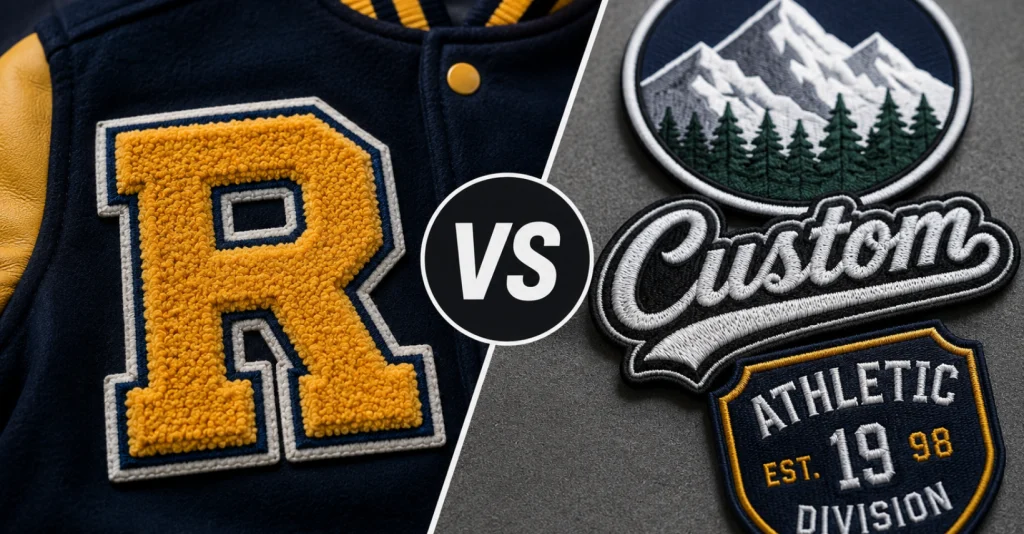
When it comes to creating a custom patch for a letterman jacket, varsity jacket, team uniform, hoodie, or branded apparel, the choice of patch style can make a major difference. Two of the most popular options are chenille letterman patches and embroidered patches. Both can create attractive, durable designs, but they offer very different textures, appearances, levels of detail, and overall personalities.
Chenille patches are famous for their soft, raised texture and classic varsity appearance. They immediately bring to mind school athletics, championship jackets, team achievements, graduation memories, and traditional American letterman style. Embroidered patches, on the other hand, are known for their detailed stitching, crisp outlines, versatility, and ability to reproduce logos, names, symbols, and more complex artwork.
So, which one works best?
The answer depends on what you want your patch to accomplish.
If your goal is a bold, traditional, three-dimensional varsity appearance, chenille may be the better choice. If you need intricate artwork, smaller lettering, detailed logos, or a flatter profile, embroidery may be more suitable. In many cases, the best-looking jackets actually combine both techniques.
At Patches Maker USA, we understand that choosing a patch is about more than simply selecting a material. Your patch represents a team, achievement, organization, business, school, club, or personal identity. That is why understanding the differences between chenille and embroidery before production is so important.
In this guide, we will compare chenille letterman patches and embroidered patches in detail, including appearance, texture, durability, design possibilities, cost considerations, applications, customization, and how to decide which option is right for your project.
What Are Chenille Letterman Patches?
Chenille letterman patches are a traditional style of patch commonly associated with varsity and letterman jackets.
Their most recognizable feature is their soft, fuzzy, raised surface. Instead of relying entirely on flat embroidery thread, chenille patches use specialized yarn to create a textured surface. This gives the finished patch a plush appearance that stands out from the garment.
Chenille has long been associated with school sports, athletic achievements, marching bands, academic accomplishments, clubs, and varsity culture. The bold texture makes the patch highly visible, especially when used for large letters, numbers, mascots, and symbols.
A typical chenille letterman patch may feature a felt or fabric base combined with chenille yarn and embroidered borders or details. The result is a patch that has both visual and physical depth.
This texture is one of the biggest reasons people choose chenille.
When someone sees a large chenille varsity letter on a jacket, they can usually recognize the style immediately. It has a heritage-inspired appearance that is difficult to replicate with flat embroidery.
Chenille is particularly effective when the design is intended to be a focal point. Large initials, school letters, sports numbers, mascots, and bold symbols can look especially impressive when produced in chenille.
What Are Embroidered Patches?
Embroidered patches are created primarily by stitching thread onto a fabric base to form a design.
Instead of the plush, raised surface associated with chenille, embroidered patches generally have a flatter and more defined appearance. The stitching can be used to create borders, lettering, logos, symbols, artwork, and decorative elements.
One of the biggest advantages of embroidery is flexibility.
Embroidered patches can be produced in many shapes and sizes and can accommodate a wide variety of designs. They are frequently used for uniforms, workwear, military-inspired apparel, clubs, organizations, hats, jackets, bags, sportswear, and promotional merchandise.
They are particularly useful when your design contains details that would be difficult to reproduce with chenille.
For example, a business logo containing several small elements may be easier to reproduce using embroidery. Likewise, names, department titles, numbers, and other smaller details can often be handled more effectively with traditional embroidery.
The final appearance is usually cleaner and flatter, making embroidered patches suitable for situations where you want a professional and versatile finish.
Chenille vs Embroidery: The Main Difference
The simplest way to understand the difference is this:
Chenille creates texture and visual impact, while embroidery provides precision and versatility.
Chenille is usually the better option when the design needs to look bold, substantial, traditional, and unmistakably varsity.
Embroidery is often the better choice when the design needs fine stitching, defined details, smaller text, or a professional appearance.
Neither option is automatically better.
The right choice depends on your design, garment, purpose, budget, and preferred aesthetic.
Here is a quick comparison:
| Feature | Chenille Letterman Patches | Embroidered Patches |
|---|---|---|
| Texture | Soft, raised, fuzzy | Smooth, stitched |
| Appearance | Bold and traditional | Clean and detailed |
| Best for | Varsity letters, numbers, mascots | Logos, names, detailed designs |
| Visual impact | Very high | High |
| Design detail | Best with bold shapes | Better for intricate details |
| Profile | Thicker | Flatter |
| Style | Classic and athletic | Versatile and professional |
| Common use | Letterman jackets and varsity apparel | Uniforms, jackets, hats, bags, merchandise |
| Customization | Strong for bold designs | Strong for detailed designs |
| Best strength | Texture and presence | Precision and flexibility |
Texture: Chenille Has the Advantage
If texture is one of your priorities, chenille is difficult to beat.
The raised yarn gives chenille letterman patches a soft, tactile surface. Instead of simply looking different, the patch actually feels different from the surrounding garment.
That physical texture creates a premium, traditional appearance.
Imagine a varsity jacket with a large school letter across the chest. A flat embroidered letter can certainly look good, but a thick chenille letter creates a much stronger classic letterman effect.
This is why chenille continues to be associated with varsity jackets and school athletic programs.
The texture can also make large designs more noticeable from a distance. Bold letters and numbers can stand out without requiring complicated artwork.
Embroidery, by comparison, generally produces a flatter surface. That can be an advantage when you want the patch to sit neatly against the garment and maintain a clean appearance.
So when choosing between the two, ask yourself:
Do you want your patch to feel as impressive as it looks?
If the answer is yes, chenille may be the better option.
Detail: Embroidery Offers More Flexibility
While chenille is excellent for bold designs, embroidery generally has an advantage when it comes to smaller details.
Fine lines, small lettering, intricate symbols, and detailed logos can require precise stitching. Embroidery provides more control over these elements than traditional chenille construction.
This does not mean chenille cannot contain embroidery.
In fact, chenille and embroidery are frequently combined. A large chenille letter can be surrounded by an embroidered border, while smaller embroidered elements can be added around or inside the design.
This combination can produce a highly distinctive finished product.
For example, a school jacket could feature:
- A large chenille varsity letter
- An embroidered graduation year
- An embroidered player number
- A small embroidered sports symbol
- An embroidered name patch
- Additional chenille achievement patches
This layered approach allows you to use the strengths of both techniques.
Which One Is Better for Letterman Jackets?
For a traditional letterman jacket, chenille is usually the first option that comes to mind.
That is because chenille has become closely associated with varsity apparel. Large letters, athletic symbols, mascots, and achievement patches look particularly natural when produced using chenille.
If you want your jacket to have an authentic old-school varsity appearance, chenille can immediately establish that visual identity.
However, that does not mean every patch on a letterman jacket should be chenille.
A jacket can look more balanced when different patch techniques are used for different elements.
For example, the primary school letter might be chenille, while a small sports logo or name could be embroidered.
This creates contrast and allows each element to perform its intended role.
Which One Is Better for Sports Teams?
Sports teams often benefit from chenille because of its strong visual presence.
A large chenille team logo can create an impressive focal point on a jacket. Team initials, player numbers, championship symbols, and athletic icons can all be designed to work with the bold nature of chenille.
Chenille is especially effective for:
- Baseball teams
- Basketball teams
- Football teams
- Hockey teams
- Soccer teams
- Wrestling teams
- Track teams
- Cheerleading squads
- Marching bands
- School athletic programs
For smaller logos or highly detailed team artwork, embroidery may be more practical.
A sports organization may therefore choose a combination of chenille and embroidery instead of limiting itself to one technique.
Which One Is Better for School Organizations?
Schools use patches for far more than athletics.
Clubs, student organizations, honor societies, academic programs, marching bands, debate teams, student councils, and other groups may use custom patches to represent membership and achievements.
For these applications, embroidered patches can offer significant flexibility.
If your organization has a detailed logo, long name, small symbol, or multiple visual elements, embroidery may reproduce the design more effectively.
Chenille is still a great choice when the design is intentionally bold and traditional.
A school could even use chenille for major achievement patches while using embroidery for smaller club or organization identifiers.
Chenille Patches for Achievement Recognition
One of the reasons chenille remains popular is its connection with achievement.
A letterman jacket is often more than clothing. It can become a visual record of someone’s school experience.
A student might add patches representing:
- Varsity participation
- Championships
- Academic achievements
- Sports positions
- Team membership
- Graduation years
- Special awards
- School organizations
- Leadership roles
- Personal accomplishments
Chenille patches can give these achievements a strong visual presence.
The raised texture makes individual accomplishments feel substantial, while the overall collection creates a personalized jacket that tells a story.
Embroidered Patches for Names and Small Text
If your patch includes a name or other small text, embroidery is often worth considering.
Embroidery allows letters to be stitched directly into the patch design with a clean appearance.
This can be useful for:
- Employee names
- Team member names
- Department names
- Job titles
- Club names
- School organizations
- Sports positions
- Numbers
- Short slogans
The exact result will always depend on the size and complexity of the artwork. Extremely small text can become difficult to reproduce regardless of the decoration method, which is why professional artwork review is important before production.
At Patches Maker USA, artwork should be evaluated with the final patch size in mind rather than simply assuming that a design that looks good on a computer screen will automatically work at any physical size.
Durability: Which Patch Lasts Longer?
Durability is one of the most common questions people ask when comparing chenille and embroidery.
The reality is that construction quality matters enormously.
A well-made chenille patch can remain attractive for years when properly attached and cared for. Likewise, a quality embroidered patch can provide long-lasting performance on jackets, uniforms, bags, and other garments.
Chenille has a thicker construction, but the raised yarn can experience different types of wear compared with embroidery.
Embroidery generally has a flatter surface, which can make it practical for garments that experience regular contact and movement.
The backing and attachment method also matter.
A patch intended for frequent washing and heavy use should be produced and attached appropriately for the garment. Sew-on applications can provide a strong long-term attachment, while other backing options may be more convenient for particular projects.
In other words, don’t choose a patch solely because someone says one type is “more durable.”
Consider the entire production system:
Patch construction + backing + attachment + garment + maintenance = long-term performance.
How Design Complexity Affects Your Choice
Your artwork should be one of the first things you consider.
Chenille generally performs best when the artwork contains:
- Large letters
- Bold numbers
- Simple mascots
- Strong outlines
- Large symbols
- Simple shapes
- Limited fine detail
Embroidery can be more appropriate when the artwork contains:
- Small lettering
- Detailed logos
- Fine lines
- Multiple design elements
- Intricate symbols
- Small decorative details
This is one of the most important differences between the two techniques.
Trying to force an extremely detailed design into a chenille format may compromise readability and appearance. Similarly, choosing embroidery for an enormous varsity letter may miss the opportunity to create the bold texture associated with traditional letterman jackets.
The goal is not to make one technique work for everything.
The goal is to choose the technique that allows your artwork to look its best.
Chenille vs Embroidery for Custom Apparel
Outside traditional letterman jackets, both patch types can be used on custom apparel.
Chenille can work especially well for fashion brands, streetwear, vintage-inspired collections, college-style apparel, and premium varsity-inspired garments.
Its raised texture can make a simple logo feel more substantial.
Embroidery, meanwhile, is highly adaptable.
It can be used on:
- Denim jackets
- Work jackets
- Uniforms
- Hats
- Hoodies
- Backpacks
- Bags
- Corporate apparel
- Club apparel
- Promotional products
The flatter construction can make embroidered patches easier to integrate into different styles of clothing.
Which Looks More Premium?
“Premium” is subjective because the two techniques communicate quality in different ways.
Chenille tends to communicate heritage, craftsmanship, nostalgia, and luxury athletic style.
Embroidery tends to communicate precision, professionalism, detail, and versatility.
If your brand wants a vintage collegiate identity, chenille can create that feeling immediately.
If your brand wants a clean corporate or professional identity, embroidery may be a better match.
Neither style inherently looks cheap or expensive.
The final quality depends on:
- Artwork preparation
- Stitch density
- Thread quality
- Yarn quality
- Base material
- Border finishing
- Backing
- Color matching
- Production accuracy
- Quality control
That is why selecting an experienced custom patch manufacturer is so important.
Color Options and Visual Appearance
Color selection is another consideration.
Embroidery provides significant flexibility for creating multicolor designs. Different thread colors can be used to reproduce logos and artwork with strong contrast and visual definition.
Chenille also supports attractive color combinations, but its traditional appearance often works best when the artwork is bold and easy to read.
Instead of using too many competing colors, many successful chenille designs rely on contrast.
For example:
Dark jacket + bright chenille letter + contrasting border
can create an immediately recognizable varsity look.
The same principle applies to embroidered patches.
Good contrast is often more important than simply adding more colors.
Size Matters
Patch size can dramatically influence which technique works best.
Large patches provide enough physical space for chenille yarn to create a strong visual effect. Large varsity letters and numbers are classic examples.
Smaller patches may benefit from embroidery because there is less room for thick chenille elements.
Before deciding on a patch style, determine the approximate finished size.
Then consider:
- How much detail must be included?
- How large is the text?
- Where will the patch be placed?
- How far away should it be readable?
- How much texture do you want?
- How often will the garment be worn?
These questions can quickly narrow down the best production method.
Chenille Patches vs Embroidered Patches for Branding
Businesses are increasingly using custom patches to create memorable apparel and merchandise.
If your goal is to promote a brand, choosing between chenille and embroidery should start with your visual identity.
A streetwear brand may love the thick, retro appearance of chenille.
A workwear company may prefer embroidered logo patches because they provide a professional and recognizable appearance.
A fashion brand may use both.
For example, the main logo on a premium varsity jacket could be made from chenille, while smaller sleeve branding could use embroidery.
This creates visual hierarchy.
The biggest design becomes the focal point, while the smaller embroidered elements support it.
Can Chenille and Embroidery Be Used Together?
Yes, and this is one of the most effective ways to create a custom letterman design.
A hybrid patch can combine the raised texture of chenille with the precision of embroidery.
For example, imagine a large letter “M.”
The main body of the letter could be chenille, creating a thick and textured appearance. An embroidered outline could then define the edges. Small embroidered stars, numbers, or lettering could be incorporated around the design.
The result combines the strengths of both techniques.
This approach is particularly useful when you want the traditional character of chenille but still need detailed elements.
Rather than asking:
“Chenille or embroidery?”
sometimes the better question is:
“Where should we use chenille, and where should we use embroidery?”
Cost Considerations
Price can vary significantly depending on the patch design.
Factors that influence custom patch pricing can include:
- Patch size
- Quantity
- Number of colors
- Design complexity
- Stitch count
- Chenille yarn requirements
- Border style
- Backing
- Attachment method
- Production time
- Custom finishing
Chenille can require more specialized construction and materials, particularly for large and highly textured patches.
Embroidered patches may be more economical for certain designs, especially when producing larger quantities of relatively straightforward shapes.
However, price should not be the only consideration.
A patch is often attached to a garment that represents your team, company, school, or brand. Saving a small amount upfront is not particularly valuable if the final patch doesn’t reproduce your artwork properly.
The better approach is to balance quality, design suitability, quantity, and budget.
What Makes a High-Quality Chenille Patch?
Not every chenille patch is produced to the same standard.
A quality chenille patch should have:
Even Yarn Coverage
The surface should look consistent rather than having obvious thin or empty areas.
Clean Edges
The shape should remain defined, especially around letters and numbers.
Strong Borders
Borders should provide structure and help protect the patch edges.
Consistent Color
The yarn and base materials should work together to create the intended visual contrast.
Accurate Artwork
The finished patch should represent the approved design rather than losing important proportions during production.
Secure Construction
The components should be properly secured so the patch remains attractive during normal use.
These details can make a major difference in the finished appearance.
What Makes a High-Quality Embroidered Patch?
For embroidered patches, quality can be evaluated through several factors.
Look for:
- Clean stitching
- Consistent thread tension
- Defined lettering
- Smooth borders
- Accurate shapes
- Good color matching
- Proper backing
- Neat finishing
- Appropriate stitch density
Poor embroidery may have loose threads, uneven edges, inconsistent stitching, or difficult-to-read text.
Professional production begins with properly prepared artwork.
A good patch manufacturer should also be able to advise whether a particular design needs to be simplified or adjusted before production.
Choosing the Right Backing
Backing is another important part of the patch decision.
Depending on the application, custom patches can be made with different attachment methods.
Common choices include:
- Sew-on backing
- Iron-on backing
- Hook-and-loop backing
- Adhesive options
- Combination attachment methods
The best choice depends on the garment and how frequently the patch will be used.
For a long-term letterman jacket, sewing may be preferred because it provides a secure attachment. For removable applications, hook-and-loop backing can be useful.
If you’re unsure which backing is appropriate, discuss the intended use with your patch manufacturer before placing the final order.
Best Applications for Chenille Letterman Patches
Chenille is particularly suitable for:
1. Varsity Jackets
This is the classic application. Large school letters and achievement designs look naturally at home on letterman jackets.
2. Sports Teams
Team logos, numbers, symbols, and athletic achievements can benefit from chenille’s bold appearance.
3. School Programs
Marching bands, clubs, honor groups, and student organizations can use chenille for distinctive achievement patches.
4. Streetwear
Chenille has become popular beyond traditional school clothing because its texture creates a strong vintage aesthetic.
5. Fashion Collections
Designers can use chenille to create premium, tactile branding on jackets, hoodies, and other apparel.
Best Applications for Embroidered Patches
Embroidered patches are highly versatile and work well for:
1. Uniforms
Professional logos and department identifiers can be reproduced in a clean format.
2. Workwear
Businesses can use embroidered patches for company branding, names, and job roles.
3. Hats
Small embroidered patches can create attractive branding on caps and other headwear.
4. Clubs and Organizations
Detailed logos and organization names can be produced in a recognizable format.
5. Promotional Merchandise
Businesses can add patches to bags, jackets, apparel, and accessories to create reusable branded merchandise.
When Should You Choose Chenille?
Choose chenille when:
- You want a classic varsity appearance.
- Your design is large and bold.
- Texture is important.
- You are creating a letterman jacket.
- You want a raised, tactile finish.
- Your design uses large letters or numbers.
- You want a vintage collegiate aesthetic.
- The patch is intended to become the focal point of the garment.
Chenille is particularly powerful when the design is simple enough to let its texture do the visual work.
When Should You Choose Embroidery?
Choose embroidery when:
- Your design contains fine details.
- You need smaller lettering.
- You want a flatter patch.
- You are creating a professional logo.
- Your patch will be used on uniforms.
- You need flexible branding options.
- You want a versatile patch for multiple garment types.
- Your artwork contains several smaller elements.
Embroidery gives you more freedom when precision is more important than texture.
When Should You Choose Both?
Choose both when you want the best characteristics of each.
This is especially effective for letterman jackets.
A large chenille letter can create the classic varsity foundation, while embroidery can add the smaller information needed to personalize the jacket.
For example:
Chenille: Main school letter
Embroidery: Student name
Embroidery: Graduation year
Chenille: Sports symbol
Embroidery: Championship details
This combination creates a more dynamic and personalized jacket.
How to Prepare Your Artwork
Regardless of which patch style you choose, artwork preparation is critical.
Before production, make sure your design has:
- Clear outlines
- Readable lettering
- Appropriate proportions
- Strong color contrast
- Correct dimensions
- High-resolution artwork
- No unnecessary tiny details
Remember that a patch is a physical product.
A design that looks perfect on a large computer monitor may contain details that are too small to reproduce clearly at the final patch size.
This is why artwork evaluation should happen before production rather than after.
Think About Where the Patch Will Go
Placement can influence your decision.
A large back patch has different requirements from a small chest patch.
For example:
Back of a varsity jacket: Chenille can create an impressive focal point.
Chest logo: Embroidery may provide a clean and professional appearance.
Sleeve detail: Smaller embroidery may be appropriate.
Large school letter: Chenille is a natural choice.
Name bar: Embroidery may be more practical.
Thinking about placement early helps you create a balanced final garment.
Don’t Choose Based on Trends Alone
Patch styles change over time.
Chenille has experienced renewed interest because vintage, collegiate, and retro-inspired fashion continues to influence apparel design. Embroidery, however, remains a dependable choice because it works across a huge range of applications.
But trends should not determine everything.
A patch should match your:
- Brand identity
- Garment
- Artwork
- Intended audience
- Budget
- Usage requirements
A fashionable patch that doesn’t suit your design is still the wrong patch.
The best custom patch is the one that supports the purpose of the garment.
Why Professional Patch Production Matters
Whether you select chenille or embroidery, production quality can make or break the final result.
A custom patch is a small item, but there are many details involved in producing it correctly.
Artwork needs to be converted into an appropriate production format. Stitching, yarn, borders, colors, backing, sizing, and finishing all need to work together.
This is where working with an experienced custom patch manufacturer can make the process easier.
At Patches Maker USA, the goal is to help customers turn their artwork into patches that are visually appealing, practical, and appropriate for their intended application.
Instead of simply choosing the most popular patch style, consider what your artwork actually needs.
Chenille Letterman Patches vs Embroidery: A Simple Decision Guide
Still unsure which one to select?
Use this quick guide.
Pick Chenille If You Want:
Classic:
A traditional varsity or letterman appearance.
Textured:
A raised, soft, tactile surface.
Bold:
Large letters, numbers, and symbols.
Athletic:
A style associated with school sports and achievements.
Statement-Making:
A patch that immediately attracts attention.
Pick Embroidery If You Want:
Detailed:
Fine design elements and more precise artwork.
Professional:
A clean and polished appearance.
Versatile:
A patch suitable for different garments and applications.
Compact:
Smaller logos, names, or symbols.
Practical:
A flatter patch that integrates easily into uniforms and apparel.
Pick Both If You Want:
Texture + Detail:
A combination of chenille’s raised appearance and embroidery’s precision.
Customization:
Different techniques for different parts of the design.
Visual Hierarchy:
A large focal point supported by smaller details.
Unique Styling:
A custom jacket that does not look like a standard mass-produced design.
Frequently Asked Questions
Are chenille patches the same as embroidered patches?
No. Although both can be used to decorate clothing, they are constructed differently. Chenille patches use raised yarn to create a soft, textured appearance, while embroidered patches primarily use stitched thread to create a flatter design.
Are chenille patches good for letterman jackets?
Yes. Chenille is one of the most recognizable styles for traditional letterman and varsity jackets. Its raised texture and bold appearance make it particularly suitable for large school letters, sports symbols, numbers, and achievement designs.
Are embroidered patches more detailed than chenille?
Generally, embroidery is more suitable for fine details and smaller lettering. Chenille performs best with bold, larger shapes because its thick yarn creates a textured surface.
Can you combine chenille and embroidery?
Yes. Combining the two techniques can create a highly customized design. A large chenille letter can be combined with embroidered borders, names, years, numbers, or smaller symbols.
Are chenille patches durable?
Quality chenille patches can be durable when properly manufactured and attached. Their longevity depends on construction quality, materials, attachment method, garment type, and care.
Are embroidered patches durable?
Quality embroidered patches can also provide excellent long-term performance. Proper stitching, backing, attachment, and garment care all contribute to durability.
Which patch type is cheaper?
There is no universal price difference because pricing depends on size, quantity, complexity, materials, backing, and production requirements. Chenille can involve additional specialized materials and construction, while embroidery may be more economical for certain designs.
Can chenille patches be used on clothing other than letterman jackets?
Absolutely. Chenille can also be used on hoodies, denim jackets, varsity-inspired streetwear, bags, fashion apparel, and other garments where a textured appearance is desired.
Can embroidered patches be used on hats?
Yes. Embroidered patches are commonly used for hats and caps, particularly when the design needs to remain relatively compact and detailed.
What is better for a large logo?
If the logo is bold and simple, chenille can create an impressive large-scale design. If the logo contains fine details, embroidery may be more appropriate.
What is better for small text?
Embroidery is generally the better option for smaller text, although the final readability will depend on the physical size and complexity of the lettering.
Can Patches Maker USA create custom chenille patches?
Yes, Patches Maker USA specializes in custom patch solutions and can help you determine whether chenille, embroidery, or a combination of techniques is appropriate for your design and application.
Final Verdict: Chenille or Embroidery?
So, which works best: chenille letterman patches or embroidery?
There isn’t one universal winner.
Chenille wins when the goal is texture, tradition, boldness, and classic varsity style. It is particularly effective for large letters, numbers, mascots, athletic symbols, and achievement patches.
Embroidery wins when the goal is precision, detail, versatility, and a clean professional appearance. It is an excellent option for logos, names, uniforms, hats, clubs, organizations, and more detailed artwork.
And when you want the benefits of both, combining chenille and embroidery can produce an even more distinctive result.
The most important thing is to choose based on your design rather than simply choosing the patch style you see most often.
A great custom patch should complement the garment, communicate your identity, and remain visually appealing long after it has been produced.
Whether you’re creating a traditional letterman jacket, designing custom team apparel, launching a streetwear collection, outfitting an organization, or developing branded merchandise, Patches Maker USA can help you turn your artwork into a custom patch designed around your specific requirements.
Start with your artwork, decide how you want the finished patch to look and feel, consider the garment and placement, and then choose the production technique that supports those goals.
Chenille brings the classic varsity character. Embroidery brings precision and flexibility. Together, they give you even more creative possibilities.