When you’re searching for Custom Patches USA, you’ll quickly discover that not every patch manufacturer delivers the same level of quality, service, customization, or durability. A patch may look simple, but creating one that accurately represents your brand, organization, team, club, or personal identity requires much more than stitching thread onto fabric.
The right manufacturer can turn your artwork into a professionally crafted patch that looks sharp, lasts through repeated use, and reflects the quality of the people or organization wearing it. The wrong manufacturer, on the other hand, may leave you with faded colors, poor stitching, inaccurate details, weak backing, or a product that simply doesn’t look like the design you approved.
Whether you need custom patches for a business uniform, sports team, motorcycle club, military-inspired apparel, school organization, promotional campaign, workwear, outdoor gear, or personal project, choosing the right patch maker is an important decision.
At Patches Maker USA, we believe customers should understand exactly what goes into creating a custom patch before placing an order. From choosing the right patch style and backing to reviewing artwork and approving the final design, every step can influence the final result.
This guide explains how to find the right custom patch manufacturer in the USA, what questions to ask before ordering, what to expect during the production process, and how to make sure your finished patches meet your expectations.
Why Choosing the Right Custom Patch Manufacturer Matters
A custom patch is more than an accessory.
For many customers, it represents something meaningful.
It may carry a company’s logo, identify a professional team, celebrate a special event, honor military service, represent a motorcycle organization, or become part of a personal clothing collection.
Because of this, the quality of the patch matters.
A professionally manufactured patch should have:
- Clean and precise stitching
- Sharp, readable lettering
- Accurate colors
- A strong and appropriate backing
- A neat border
- Durable construction
- A professional overall appearance
If the patch is being used on uniforms or branded apparel, quality is even more important. Your patch becomes part of how customers, employees, clients, and the public see your organization.
A poorly made logo patch can make an otherwise professional uniform look inexpensive. A high-quality patch, however, can enhance the appearance of the entire garment.
The same applies to clubs, teams, organizations, and personal projects.
Your patch should represent your identity accurately.
That is why finding the right Custom Patches USA manufacturer should involve more than searching for the lowest price.
You should consider craftsmanship, communication, customization options, production capabilities, backing choices, turnaround expectations, and the manufacturer’s ability to understand your design.
What Are Custom Patches?
Custom patches are specially manufactured patches created according to a customer’s artwork, logo, text, shape, colors, or design requirements.
Unlike mass-produced patches, custom patches are made specifically for your project.
You can customize elements such as:
- Shape
- Size
- Colors
- Text
- Artwork
- Border
- Backing
- Material
- Finish
- Attachment method
This flexibility makes custom patches suitable for a wide range of applications.
Businesses may use them for branding and uniforms. Sports teams may use them for jerseys, jackets, and bags. Schools may create patches for clubs and activities. Motorcycle groups may order custom club patches and rockers. Military and veteran organizations may create commemorative designs.
Fashion brands can also use patches as a creative way to add personality to garments and accessories.
The possibilities are extensive.
The key is working with a manufacturer that understands how to translate your idea into a finished product.
How to Find the Right Custom Patches USA Manufacturer
Finding a patch manufacturer can be easy.
Finding the right manufacturer requires more research.
Before choosing a company, consider the following factors.
1. Review the Manufacturer’s Patch Portfolio
One of the first things you should do is examine examples of the manufacturer’s previous work.
A portfolio can tell you a lot about production capabilities.
Look for examples that demonstrate:
- Detailed embroidery
- Clean borders
- Small lettering
- Multiple colors
- Complex artwork
- Different patch shapes
- Various backing options
Pay particular attention to designs similar to your own.
For example, if you need a detailed business logo, look for examples of custom logo patches. If you’re ordering a motorcycle patch, review examples of motorcycle club patches and rockers.
If the manufacturer regularly produces the type of patch you need, they are more likely to understand the technical requirements involved.
At Patches Maker USA, our approach is centered around helping customers turn their ideas into professionally crafted patches suitable for a wide range of applications.
2. Check the Available Patch Types
A quality custom patch manufacturer should offer multiple production options.
Not every design is best suited to traditional embroidery.
Depending on your artwork and intended use, you may want:
- Custom Embroidered Patches
- Custom Woven Patches
- Custom PVC Patches
- Custom Leather Patches
- Custom Velcro Patches
- Custom Logo Patches
- Custom Name Patches
- Military Patches
- Motorcycle Patches
- Event Patches
- Promotional Patches
Having access to multiple patch styles gives you greater flexibility.
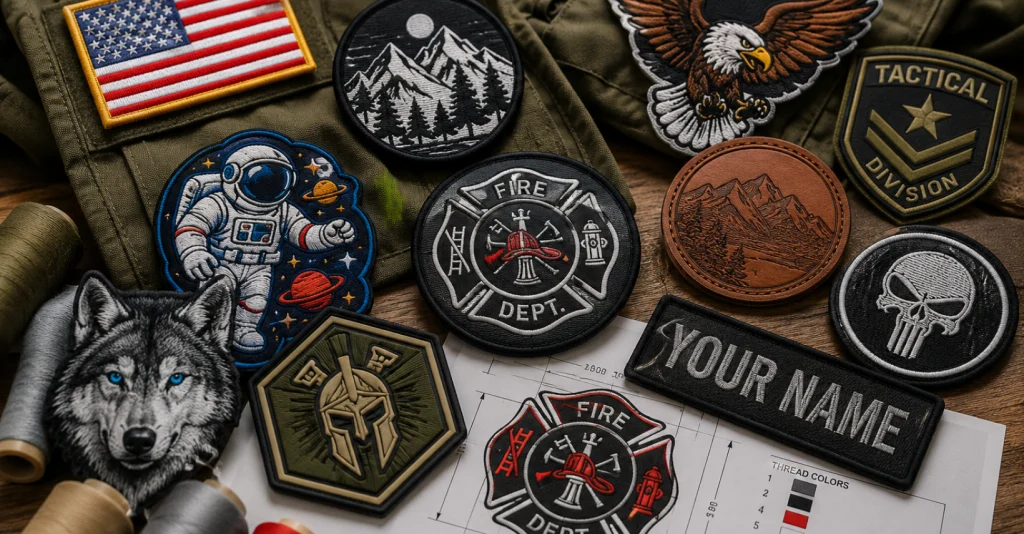
For example, embroidered patches provide a classic textured appearance, while woven patches can reproduce finer details and smaller text. PVC patches are excellent for outdoor and tactical applications, while leather patches provide a distinctive premium aesthetic.
The right manufacturer should help you determine which option is best for your project rather than pushing every customer toward the same product.
3. Consider the Manufacturer’s Customization Capabilities
A true custom patch manufacturer should be able to work with your specific requirements.
Before ordering, ask about customization options.
Can you choose:
- Custom shapes?
- Custom dimensions?
- Multiple thread colors?
- Different borders?
- Special backing?
- Custom lettering?
- Detailed artwork?
- Different materials?
These details can significantly affect the appearance of your finished patch.
For example, a circular patch may be perfect for a club logo, while a shield-shaped patch may work better for a sports team or security organization.
Likewise, a rectangular name patch may be ideal for work uniforms, whereas a custom die-cut design could be better for promotional merchandise.
The more flexibility a manufacturer provides, the easier it becomes to create a patch that genuinely reflects your vision.
4. Look at the Quality of the Artwork and Digitizing Process
Your artwork is the foundation of your patch.
However, a digital image cannot simply be copied directly onto fabric.
For embroidered patches, the artwork must be converted into a format that embroidery machines can understand. This process is commonly known as digitizing.
Good digitizing determines:
- Stitch direction
- Stitch density
- Thread placement
- Lettering clarity
- Detail reproduction
- Color separation
Poor digitizing can result in:
- Uneven stitching
- Blurred details
- Poorly defined letters
- Excessive thread density
- Gaps in the design
- An untidy appearance
This is particularly important when your design includes small text or intricate artwork.
A professional patch manufacturer should understand the limitations of embroidery and make adjustments where necessary without compromising the overall concept.
At Patches Maker USA, the goal is to create designs that are not only visually appealing on screen but also practical and effective when transformed into physical patches.
5. Ask About Material Quality
The materials used to make your patch directly influence its appearance and durability.
For embroidered patches, thread quality matters.
For PVC patches, the quality and flexibility of the PVC material are important.
For leather patches, the leather or leather-like material and finishing process can influence the final look.
For woven patches, the quality of the woven construction affects the clarity of fine details.
A good manufacturer should be able to explain what materials are used and why they are suitable for your intended application.
If your patch will be worn outdoors, exposed to moisture, or used frequently, material selection becomes especially important.
A patch designed for a casual fashion jacket may have very different requirements from one used on outdoor gear or professional workwear.
6. Choose a Manufacturer That Offers the Right Backing
Backing is one of the most important decisions when ordering custom patches.
The right option depends on how and where the patch will be used.
Common backing options include:
Sew-On Backing
Sew-on patches are attached directly to the garment using thread.
This is a popular option for:
- Jackets
- Uniforms
- Motorcycle vests
- Workwear
- Heavy-duty clothing
Sewing generally provides a strong and permanent attachment.
Iron-On Backing
Iron-on patches use heat to activate an adhesive layer.
They are convenient for customers who want to apply patches without sewing.
They can work well on suitable fabrics, although the material and application method should always be considered.
Adhesive Backing
Adhesive patches can be attached using a sticky backing.
These are often useful for temporary applications, promotional items, or situations where a quick attachment method is required.
Hook-and-Loop Backing
Often associated with Velcro-style applications, hook-and-loop backing allows patches to be removed and replaced.
This makes it particularly useful for:
- Tactical gear
- Military-style uniforms
- Law enforcement applications
- Security uniforms
- Outdoor equipment
- Backpacks
If you expect to change your patch regularly, hook-and-loop backing may be the ideal choice.
The best manufacturer will help you choose the backing that matches the intended use of your patch.
7. Look for Clear Communication
Communication is often overlooked when customers compare patch manufacturers.
However, it can make a major difference.
Imagine submitting your artwork and receiving a finished patch that doesn’t look the way you expected.
Maybe the lettering is too small.
Perhaps the colors aren’t right.
Maybe the patch is larger than you anticipated.
Good communication helps prevent these problems.
Before production begins, you should have a clear understanding of:
- Patch size
- Patch type
- Colors
- Shape
- Border
- Backing
- Quantity
- Production timeline
- Shipping expectations
A manufacturer should be willing to answer your questions and clarify technical details.
At Patches Maker USA, we understand that customers may not be familiar with embroidery production, digitizing, backing options, or patch construction. That’s why the process should be straightforward and easy to understand.
8. Ask About Design Approval
One of the most important parts of ordering custom patches is reviewing the design before production.
Whenever possible, customers should have the opportunity to review a digital proof or design representation before manufacturing begins.
This allows you to check:
- Spelling
- Colors
- Dimensions
- Logo placement
- Text size
- Shape
- Overall appearance
A simple review at this stage can prevent expensive mistakes later.
Always take your time when reviewing artwork.
If you notice something that needs to be changed, communicate it before production begins.
9. Consider the Manufacturer’s Experience
Experience doesn’t automatically guarantee quality, but it can be a valuable indicator.
An experienced manufacturer is more likely to understand the challenges involved in producing different types of patches.
They may know how to handle:
- Complex logos
- Small lettering
- Detailed artwork
- Large patches
- Unusual shapes
- Multiple borders
- Different backing requirements
They may also be better equipped to recommend solutions when your original design isn’t technically ideal for the chosen patch style.
Instead of simply saying, “Yes, we can make that,” an experienced patch maker should be able to explain how your design can be produced effectively.
10. Compare Quality, Not Just Price
Price is obviously an important consideration.
However, the cheapest option isn’t always the best value.
When comparing manufacturers, consider the complete package.
Ask yourself:
- Is the artwork professionally digitized?
- Are quality materials being used?
- Is the stitching clean?
- Are colors accurate?
- Is the backing appropriate?
- Is the manufacturer responsive?
- Is there a design review process?
- Does the final product match the approved artwork?
A low-cost patch that needs to be replaced quickly may ultimately cost more than a quality patch that lasts for years.
When ordering patches for a business, team, or organization, the cost of poor quality can also extend beyond the product itself.
Your patches represent your identity.
Quality matters.
Understanding the Main Types of Custom Patches
One of the biggest advantages of working with a professional Custom Patches USA manufacturer is the ability to choose the patch style that best fits your project.
Let’s look at the most popular options.
Custom Embroidered Patches
Embroidered patches remain one of the most popular choices.
They offer a classic, textured appearance created through stitching and thread.
They are commonly used for:
- Company logos
- Sports teams
- Schools
- Clubs
- Uniforms
- Motorcycle groups
- Events
- Organizations
The raised texture of embroidered thread creates a traditional appearance that works well across many applications.
If you’re looking for a timeless patch style, embroidered patches are an excellent starting point.
Custom Woven Patches
Woven patches are created using thinner threads woven closely together.
This allows them to reproduce finer details than traditional embroidery in many cases.
They are particularly useful for:
- Detailed artwork
- Small lettering
- Intricate logos
- Modern branding
- Flat designs
If your artwork includes details that may be difficult to reproduce with thick embroidery threads, a woven patch may be worth considering.
Custom PVC Patches
PVC patches offer a modern alternative to traditional fabric patches.
They are made from a durable synthetic material and are particularly popular for outdoor, tactical, and performance applications.
PVC patches can offer:
- Waterproof characteristics
- Easy cleaning
- Strong durability
- A modern appearance
- Excellent dimensional effects
They are commonly used for:
- Tactical gear
- Outdoor equipment
- Backpacks
- Work gear
- Military-inspired applications
- Adventure brands
If your patch will be exposed to challenging conditions, PVC can be an excellent choice.
Custom Leather Patches
Leather patches offer a distinctive appearance.
They are particularly popular in:
- Fashion
- Denim
- Premium apparel
- Motorcycle clothing
- Outdoor brands
- Heritage-inspired products
A leather patch can create a rugged, sophisticated, or vintage feel depending on how it is designed.
For clothing brands, custom leather patches can also add a premium branding element to hats, jackets, jeans, and other apparel.
Custom Velcro Patches
Custom Velcro patches provide flexibility.
Instead of permanently attaching the patch, the wearer can remove and replace it as needed.
This is particularly useful for:
- Tactical uniforms
- Military-style clothing
- Security gear
- Backpacks
- Outdoor equipment
- Swappable branding
Organizations that require different identifiers for different situations may find hook-and-loop patches especially convenient.
Custom Patches for Businesses and Brands
Businesses are increasingly using patches as a creative branding tool.
A custom patch can be added to:
- Employee uniforms
- Hats
- Jackets
- Work shirts
- Bags
- Promotional merchandise
Compared with traditional printed branding, patches offer a tactile and dimensional appearance.
They can also become part of a company’s long-term visual identity.
For example, a restaurant might use logo patches on staff uniforms. An outdoor company could add embroidered patches to jackets and backpacks. A clothing brand might incorporate leather patches into denim products.
The possibilities are virtually unlimited.
A well-designed patch can help your brand stand out while creating a more memorable visual experience.
Custom Logo Patches: Turning Branding Into Something Wearable
Your logo is one of your company’s most important visual assets.
Turning it into a custom patch can give your branding a physical presence.
However, not every logo translates perfectly into every patch style.
Before manufacturing, consider:
Logo Complexity
Highly detailed logos may require a woven or PVC format rather than traditional embroidery.
Text Size
Small lettering may become difficult to read when embroidered.
Color Count
Some designs use many colors, so discuss how the manufacturer will reproduce them accurately.
Patch Size
Increasing the patch size may help preserve small details and improve readability.
Application
Consider where the patch will be placed.
A logo patch for a hat may require a different design approach than one intended for a jacket or large uniform.
A professional manufacturer can help you adapt your logo without losing its identity.
Custom Patches for Sports Teams
Sports patches are an excellent way to create team identity.
They can be used on:
- Jerseys
- Jackets
- Caps
- Duffel bags
- Backpacks
- Team apparel
A team patch may include:
- Team name
- Mascot
- Player number
- Season
- Championship year
- School name
- League information
Because sports apparel is often worn repeatedly and washed frequently, durability is an important consideration.
The patch should maintain its appearance throughout the season and beyond.
Custom Patches for Schools and Organizations
Schools, universities, clubs, and community organizations can use custom patches to create a sense of belonging.
Patches may commemorate:
- Student organizations
- Academic achievements
- Sports programs
- School events
- Graduation
- Clubs
- Fundraising campaigns
For students, receiving a patch can represent participation or achievement.
For organizations, patches can create a visual connection between members.
This makes custom patches more than decoration. They can become symbols of shared experiences.
Custom Military and Veteran Patches
Military-inspired and veteran patches carry significant meaning.
They may commemorate:
- Military service
- Units
- Missions
- Deployments
- Special events
- Veteran organizations
- Memorials
Because these patches can have deep personal significance, accuracy is particularly important.
The design, colors, wording, and symbolism should be carefully considered.
Many customers choose embroidered patches for a traditional appearance, while PVC and hook-and-loop options may be preferred for modern tactical applications.
Whatever the purpose, the manufacturer should treat the project with attention to detail.
Custom Motorcycle Patches and Rockers
Motorcycle patches have a long-standing connection with identity, community, and personal expression.
They are commonly used on:
- Leather vests
- Riding jackets
- Club apparel
- Event merchandise
Popular designs include:
- Club patches
- Memorial patches
- Event patches
- Chapter patches
- Officer patches
- Rockers
Motorcycle patches are often exposed to outdoor conditions, friction, sunlight, and weather.
This makes durability particularly important.
For riders and clubs, a patch isn’t simply something decorative. It may represent years of memories, friendships, achievements, and shared experiences.
That’s why choosing the right manufacturer is so important.
What to Expect When Ordering Custom Patches
If you’ve never ordered custom patches before, the process may seem complicated.
Fortunately, it can be quite straightforward when you work with the right manufacturer.
Here’s what you can generally expect.
Step 1: Submit Your Artwork
Start by providing your logo, image, sketch, or design concept.
The manufacturer will review the artwork and determine how it can be produced.
If you don’t have finished artwork, you may need assistance preparing the design.
Step 2: Choose Your Patch Type
You’ll need to select the production style.
This may include:
- Embroidered
- Woven
- PVC
- Leather
- Velcro-backed
Your choice should depend on your design, budget, application, and desired appearance.
Step 3: Select Your Size and Shape
Decide how large you want your patch to be.
Common shapes include:
- Round
- Oval
- Square
- Rectangle
- Shield
- Custom die-cut
The size should be appropriate for the item where the patch will be applied.
Step 4: Choose Your Backing
Select the attachment method.
Depending on your needs, you may choose:
- Sew-on
- Iron-on
- Adhesive
- Hook-and-loop
If you’re unsure, ask the manufacturer for guidance.
Step 5: Review the Design
Before production begins, carefully review the design.
Check:
- Spelling
- Colors
- Size
- Shape
- Text
- Placement
- Borders
This is your opportunity to request changes.
Step 6: Production Begins
Once the design is approved, production can begin.
The exact manufacturing process depends on the patch type.
Embroidered patches require digitizing and stitching.
Woven patches require specialized weaving.
PVC patches require molding and material production.
Leather patches require cutting, printing, embossing, engraving, or other finishing processes.
Each method requires different expertise.
Step 7: Quality Inspection
Before the order is completed, the finished patches should be checked for quality.
The manufacturer should look for issues such as:
- Loose threads
- Uneven borders
- Incorrect colors
- Manufacturing defects
- Incorrect dimensions
Quality control helps ensure that the final product matches the expected standard.
Step 8: Delivery
Once production and quality checks are complete, your patches are prepared for delivery.
At this point, your custom design is ready to become part of your apparel, uniform, gear, merchandise, or collection.
Questions to Ask Before Ordering Custom Patches
Before choosing a manufacturer, consider asking:
What patch types do you offer?
Make sure the manufacturer can produce the style you need.
Can you work with my artwork?
Ask about accepted file formats and design requirements.
Do you provide a design proof?
A proof can help prevent production mistakes.
What backing options are available?
Choose an attachment method based on your application.
What is the expected production timeline?
Make sure the timeline works with your event, launch, or project.
Can you produce complex designs?
If your artwork is detailed, ask about its suitability for your chosen patch type.
What materials do you use?
Understanding material quality can help you make a better decision.
How should I care for the finished patches?
Different materials may have different cleaning and maintenance requirements.
The answers to these questions can help you identify a manufacturer that is genuinely prepared to handle your project.
Common Mistakes to Avoid When Ordering Custom Patches
Even with a good manufacturer, customers can make mistakes that affect the final result.
Here are some of the most common.
Choosing the Cheapest Option
Price is important, but quality should not be ignored.
A very low price may indicate compromises in materials, production, or service.
Using Too Much Detail in a Small Patch
Tiny details may not reproduce clearly in embroidery.
If your patch is small, simplify the design where necessary.
Choosing the Wrong Patch Type
Not every design is ideal for embroidery.
Some designs may look better as woven, PVC, or leather patches.
Ignoring the Application Method
A patch for a backpack may require different backing from a patch for a jacket.
Think about how the patch will actually be used.
Failing to Check the Proof
Always review the design carefully before production.
A small spelling mistake can become a major problem once hundreds of patches have been manufactured.
Ordering Without Considering Durability
Think about how often the patch will be worn and what conditions it will experience.
Outdoor and heavy-use applications require more durable solutions than occasional fashion use.
How to Get the Best Results From Your Custom Patches
If you want your patches to look professional, start with a strong design.
Keep your artwork:
- Clear
- Balanced
- Readable
- Visually distinctive
Avoid overcrowding the design with unnecessary elements.
If your patch includes text, make sure the lettering is large enough to remain readable.
Choose colors that provide enough contrast.
Consider how the patch will look against the garment or surface where it will be placed.
Most importantly, communicate your goals with the manufacturer.
Tell them:
- Where the patch will be used
- How often it will be worn
- Whether it will be exposed to weather
- Whether it needs to be removable
- Whether it is for branding or personal use
The more information you provide, the easier it becomes to recommend the right solution.
Why Choose Patches Maker USA for Your Custom Patches?
At Patches Maker USA, we understand that every patch tells a story.
Whether you’re creating a logo patch for your business, a team patch for your organization, a commemorative patch for a special event, or a custom design for personal use, we focus on helping you create a product that looks professional and represents your vision.
Our patch solutions can support a wide range of applications, including:
- Businesses
- Clothing brands
- Sports teams
- Schools
- Motorcycle organizations
- Military and veteran groups
- Outdoor enthusiasts
- Clubs
- Events
- Personal projects
We understand that no two projects are exactly the same.
That’s why choosing the right material, patch style, size, border, and backing is an important part of the process.
Whether your project calls for the classic texture of embroidered patches, the modern durability of PVC, the precision of woven construction, the premium look of leather, or the flexibility of hook-and-loop backing, the goal is to create a finished product that fits your needs.
Our focus is on combining creative customization with quality craftsmanship so your patches can become a meaningful part of your brand, apparel, uniform, or organization.
The Benefits of Working With a Dedicated Custom Patch Manufacturer
When you work directly with a specialized patch manufacturer, you can often receive more personalized guidance than you would from a general promotional product supplier.
A dedicated manufacturer understands the technical differences between patch types.
They know how design choices affect production.
They can help identify potential problems before manufacturing begins.
They can also recommend alternatives when your original idea may not work effectively with your chosen material.
For example, if your logo contains extremely small text, they may recommend a woven patch.
If your patch will be exposed to water and outdoor conditions, PVC may be more suitable.
If you need to change the patch regularly, hook-and-loop backing could be the better choice.
This kind of guidance can save time, reduce mistakes, and help you get a better final product.
Final Checklist Before Ordering Custom Patches USA
Before placing your order, take a moment to review this checklist.
Design
- Is your artwork clear?
- Is the text readable?
- Are the colors correct?
- Is the design suitable for your chosen patch type?
Size
- Is the patch large enough for the details?
- Will it fit the intended garment or product?
Material
- Is embroidery right for your project?
- Would woven, PVC, or leather work better?
Backing
- Do you need sew-on?
- Iron-on?
- Adhesive?
- Hook-and-loop?
Quality
- Have you reviewed the manufacturer’s portfolio?
- Have you checked examples of similar work?
Production
- Do you understand the expected timeline?
- Have you approved the final design?
Application
- Do you know how the patch will be attached?
- Is the attachment method suitable for the fabric or surface?
Answering these questions before production begins can make the ordering process significantly easier.
Final Thoughts: Finding the Right Custom Patches USA Manufacturer
Finding the right Custom Patches USA manufacturer is about more than finding someone who can turn artwork into a physical patch.
You need a partner who understands design, materials, production, backing options, and the practical demands of your project.
The best manufacturer should offer customization, communicate clearly, provide quality options, and help you make informed decisions.
Whether you’re ordering custom embroidered patches for your company, PVC patches for outdoor gear, woven patches for detailed artwork, leather patches for premium apparel, Velcro patches for tactical applications, or custom motorcycle patches for your riding community, the right manufacturer can make a significant difference.
At Patches Maker USA, we believe your patch should represent your vision with quality and confidence.
From the first artwork submission to the final product, every detail matters.
So, before you place your next custom patch order, take the time to evaluate the manufacturer carefully. Review their capabilities, ask questions, compare patch options, consider the intended application, and make sure you understand the production process.
When you choose the right partner, your custom patches can become more than simple accessories.
They can become recognizable symbols of your business, your team, your organization, your community, or your personal story.
If you’re ready to transform your artwork into professionally made custom patches, Patches Maker USA is here to help you create patches designed around your needs and your identity.