A letterman jacket is more than just another piece of clothing. For many students, athletes, graduates, clubs, and organizations, it represents years of hard work, dedication, teamwork, achievement, and memories. Every letter, number, name, mascot, and emblem added to a jacket tells part of a story.
That is why choosing the right type of patch matters.
When you start planning a custom varsity jacket, one of the biggest decisions you may face is whether to use chenille letterman patches or embroidered patches. Both options can create an impressive finished look, but they offer very different textures, visual effects, design possibilities, and overall styles.
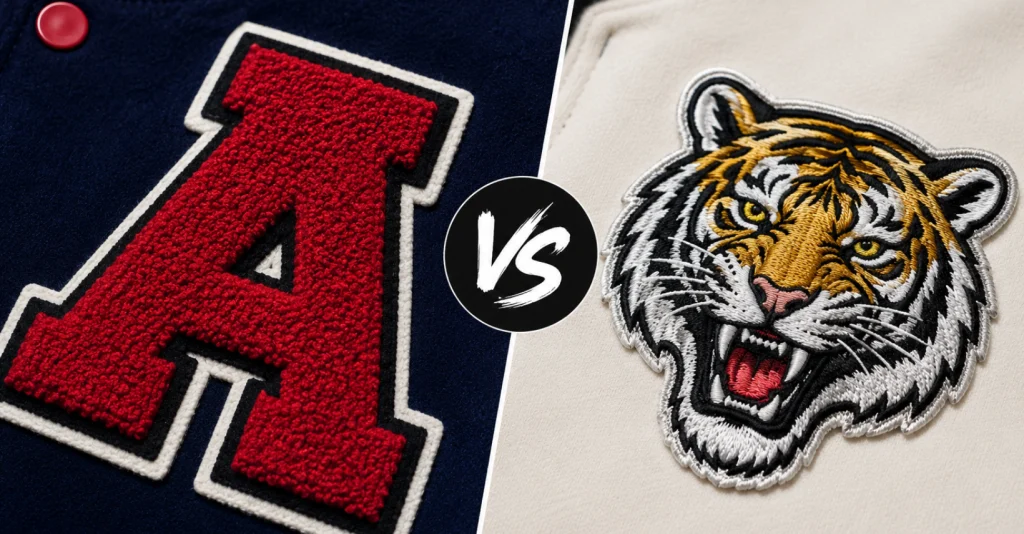
Chenille patches are known for their thick, raised, three-dimensional appearance and classic varsity appeal. Embroidered patches, on the other hand, provide sharp details, clean lines, and greater flexibility for intricate artwork. Neither is automatically better than the other. The right choice depends on what you want your jacket, uniform, team apparel, or organization merchandise to communicate.
At Patches Maker USA, we understand that custom patches are not simply decorative accessories. They are a way to showcase identity, celebrate accomplishments, and create something people are proud to wear. That is why understanding the differences between chenille and embroidery can help you make a better decision before production begins.
In this guide, we will compare chenille letterman patches vs. embroidery, looking at appearance, texture, durability, design flexibility, comfort, cost, customization, and the best applications for each option. We will also explore why combining both styles can sometimes create the most impressive result.
Let’s get started.
What Are Chenille Letterman Patches?
Chenille letterman patches are a traditional choice for varsity jackets and school apparel. They are instantly recognizable because of their thick, raised, textured surface. Instead of creating the design entirely with flat embroidery thread, chenille patches use specialized yarn to create a soft, fuzzy, three-dimensional effect.
The result is a patch that has a noticeable presence.
When you see a large chenille letter stitched onto a varsity jacket, you immediately associate it with school traditions, athletic achievements, championships, and classic American letterman style. This connection is one of the biggest reasons chenille remains popular decades after its introduction.
Chenille is particularly effective for:
- Large varsity letters
- School initials
- Sports team numbers
- Athletic achievements
- Mascots
- Graduation years
- Championship designs
- Club and organization emblems
- Traditional school jacket designs
One of the defining characteristics of chenille is its ability to make simple designs look powerful. A large letter with a contrasting border can stand out from across a gymnasium or football field. The raised texture catches the light and gives the jacket a premium, substantial appearance.
For anyone trying to recreate the traditional letterman jacket aesthetic, chenille is difficult to replace.
What Are Embroidered Patches?
Embroidered patches are made by stitching thread onto a fabric backing to create a design. Depending on the artwork and production method, embroidery can range from relatively simple lettering to detailed logos and complex visual compositions.
Compared with chenille, embroidery generally has a flatter surface. This makes it particularly useful when precision and detail are more important than texture.
Embroidered patches are commonly used for:
- Team logos
- Club emblems
- Names
- Sponsor logos
- Company branding
- School insignias
- Military-inspired designs
- Event patches
- Uniform identification
- Personalized apparel
One of embroidery’s biggest advantages is its versatility. You can create designs with multiple colors, fine outlines, detailed lettering, and smaller visual elements.
If chenille is the traditional choice for making a bold statement, embroidery is often the better choice when you need more control over the artwork.
That difference becomes especially important when designing custom patches for modern teams, schools, businesses, and organizations.
Chenille vs. Embroidery: The First Difference Is Texture
The easiest way to distinguish chenille from embroidery is to look at the surface.
Chenille is raised.
Embroidery is generally flatter.
This may seem like a small difference, but it completely changes the character of the finished patch.
Chenille has a tactile quality. When you touch it, you immediately notice the thickness of the yarn. It feels substantial and textured. This is part of what gives chenille varsity patches their traditional identity.
Embroidery has a cleaner, more refined appearance. The thread creates a tightly stitched surface that can define lines, borders, and details with precision.
Think about the visual message you want your jacket to send.
If you want someone to see the patch and immediately think classic varsity, chenille is probably the natural choice.
If you want someone to notice the artwork, logo, or fine details, embroidery may be more suitable.
At PatchesMakerUSA.com, we help customers think beyond simply asking which material is “better.” The more useful question is: Which patch style is better for your specific design?
The Classic Appeal of Chenille Letterman Patches
There is a reason chenille has remained closely associated with letterman jackets.
It has history.
For generations, students and athletes have worn varsity jackets featuring large chenille letters that represent their schools, teams, and achievements. The look has become part of the culture surrounding high school sports, college athletics, marching bands, clubs, and other organizations.
A chenille patch can instantly make a jacket feel traditional.
Imagine a varsity jacket with a large school letter on the front, a graduation year on the sleeve, and a sports achievement patch on the back. The raised chenille elements give the entire garment a sense of heritage.
This is particularly valuable for schools and teams that want to preserve a classic identity.
Chenille also works exceptionally well when the design needs to be visible from a distance. Large letters and bold shapes have a strong visual impact, making them ideal for athletic jackets and team apparel.
If your priority is tradition, nostalgia, and a recognizable varsity aesthetic, chenille has a clear advantage.
Where Chenille Works Best
Chenille is most effective when the design is bold and uncomplicated.
Large letters are perhaps the most obvious example.
A single initial can look incredible when produced in thick chenille yarn with a contrasting border. Numbers can also work extremely well, especially when they represent a player’s jersey number or an important team achievement.
Chenille is also excellent for:
School Letters
The classic varsity letter remains one of the most popular applications for chenille. A large letter on the front of a jacket can immediately communicate school pride and athletic participation.
Team Numbers
Players can use chenille numbers to represent their jersey number, championship season, or another meaningful achievement.
Graduation Years
A large year patch can commemorate a graduating class and turn a jacket into a lasting keepsake.
Simple Mascots
Mascots with strong silhouettes and uncomplicated shapes can look impressive in chenille, particularly when the design uses bold outlines and contrasting colors.
Achievement Symbols
Stars, trophies, championship icons, and other simple symbols can complement a chenille varsity design.
The key is to let chenille do what it does best: create visual impact through size, texture, and simplicity.
The Limitations of Chenille
While chenille has many advantages, it is not ideal for every design.
The same thick, textured yarn that makes chenille attractive can make very detailed artwork difficult to reproduce.
Tiny lettering can become difficult to read. Intricate lines may lose definition. Highly detailed illustrations may not translate well into the thick chenille format.
For example, if you have a logo with very small text and several fine details, chenille may not be the best option.
Trying to force a highly complicated design into chenille can result in an artwork that looks crowded or unclear.
That is why design planning is so important.
A professional patch manufacturer should be able to review your artwork and help determine whether the design is suitable for chenille, embroidery, or a combination of both.
At Patches Maker USA, the goal should always be to help customers create patches that look good in the real world—not simply approve every design exactly as submitted without considering how the final patch will appear.
Why Embroidery Remains So Popular
Embroidery has a different set of strengths.
Its biggest advantage is precision.
Because embroidery thread can be used to create defined lines and detailed patterns, embroidered patches are often a better choice for designs that require more visual complexity.
You can incorporate multiple colors, outlines, lettering, symbols, and detailed artwork into an embroidered patch.
This makes embroidery a popular option for:
- Sports team logos
- School emblems
- Business branding
- Club patches
- Event badges
- Names and initials
- Uniform patches
- Organization insignias
- Detailed illustrations
Embroidery is also extremely versatile in terms of placement.
It can be used on jackets, hats, shirts, bags, uniforms, backpacks, and many other garments and accessories.
While chenille is strongly associated with varsity jackets, embroidery can adapt to almost any apparel application.
Embroidery and Fine Details
One of the most important differences between embroidery and chenille is the ability to handle detail.
Suppose your school has a detailed crest featuring multiple elements. Perhaps it includes a shield, stars, a mascot, a banner, and several words.
That design may be challenging to reproduce using chenille.
Embroidery gives you greater control.
Fine lines can be stitched more precisely. Smaller text can often be reproduced more effectively, provided the lettering is large enough for the chosen production method. Multiple colors can also be combined to create a more sophisticated visual effect.
This makes embroidery particularly valuable for modern branding.
Businesses, sports clubs, schools, and organizations often need patches that closely represent their existing logos. When brand recognition depends on specific details, embroidery can offer more flexibility.
Which One Is More Durable?
Durability is one of the most common questions customers ask.
The truth is that both chenille and embroidered patches can be highly durable when they are manufactured properly.
The quality of production matters.
A well-made chenille patch can remain attached to a jacket for many years. The same is true for a high-quality embroidered patch.
However, each material may show wear differently.
Chenille has a thicker surface, which gives it a substantial appearance. Depending on how the patch is used and maintained, the yarn can eventually show signs of wear. Heavy friction, rough washing, or repeated exposure to harsh conditions can affect the texture.
Embroidery has a tighter, flatter construction. Its threads can hold their appearance well through regular use, although colors may eventually fade depending on exposure to sunlight, washing, and general wear.
The most important factors include:
- Stitch quality
- Thread quality
- Backing choice
- Edge finishing
- Attachment method
- Garment quality
- Washing and care
- Frequency of use
This is why choosing a reliable custom patch manufacturer is so important.
The difference between a patch that lasts for years and one that begins to deteriorate quickly often comes down to production quality rather than whether you selected chenille or embroidery.
Chenille Letterman Patches and Everyday Wear
Chenille patches are often chosen for special jackets rather than everyday uniforms.
This is not because they cannot be durable. It is because their visual and physical characteristics make them particularly suited to statement pieces.
A varsity jacket with a large chenille letter feels like something worth keeping.
It becomes a memory.
Students may wear it during games, school events, graduation celebrations, and reunions. Years later, the jacket may be stored as a reminder of a specific period of life.
That emotional value is part of the appeal.
For daily workwear or uniforms, however, embroidery may be more practical. Its flatter profile can make it easier to wear regularly, particularly when the garment needs to be comfortable during movement.
This is where the intended use of the jacket or apparel should guide your decision.
Comfort and Weight: Does It Matter?
It can.
Large chenille patches generally have more physical presence than embroidered patches. The raised yarn adds thickness and texture, which contributes to the classic look but can also add weight.
For a varsity jacket, that may be exactly what you want.
The weight and texture make the garment feel substantial and authentic.
For lightweight apparel, however, a large chenille patch may feel less practical.
Embroidered patches tend to have a flatter profile, making them easier to integrate into everyday clothing and accessories.
If your patch is going on a heavy varsity jacket, the difference may not be significant.
If you are adding patches to a lightweight shirt, cap, or thin jacket, embroidery may be the more comfortable choice.
Design Flexibility: Embroidery Takes the Lead
When it comes to design flexibility, embroidery generally has the advantage.
You can create more detailed artwork, incorporate more complex shapes, and reproduce branding elements with greater precision.
Chenille has a more specific visual language.
It works best with:
- Bold letters
- Large numbers
- Simple symbols
- Strong outlines
- Limited detail
- High-contrast designs
Embroidery can accommodate a broader range of artwork.
This does not mean chenille is less creative.
In fact, the restrictions of chenille can encourage better design decisions. A bold, simplified design can often look more powerful than an overly complicated one.
The key is understanding the strengths of each method.
Color Options and Visual Impact
Both chenille and embroidery can be customized with different colors, but they create different visual effects.
Chenille colors often appear rich and bold because of the thickness of the yarn. The raised texture can create subtle changes in how light interacts with the patch.
Embroidery provides a more controlled appearance. Multiple thread colors can define different sections of a logo or design.
When choosing colors, consider contrast.
A patch should be easy to recognize against the jacket or garment underneath it.
For varsity jackets, traditional combinations such as contrasting school colors can create an instantly recognizable appearance.
For modern organizations, more sophisticated combinations may be appropriate.
At Patches Maker USA, the design process should focus on making sure your patch colors work together as part of the entire garment rather than viewing the patch in isolation.
Chenille vs. Embroidery: Which Is More Affordable?
Cost is naturally an important consideration.
There is no universal price difference because the cost of a custom patch depends on several variables.
These can include:
- Patch size
- Number of colors
- Design complexity
- Quantity ordered
- Production method
- Backing type
- Border style
- Attachment method
- Customization requirements
Chenille can sometimes be more expensive because of its materials and production process. Large chenille patches also require more physical material and can involve additional production work.
Embroidery may offer a more economical solution for certain designs, particularly when the patch is smaller or when large quantities are being produced.
However, price should not be the only consideration.
A cheaper patch that does not meet your expectations can become more expensive if you have to replace it or reorder the entire batch.
The better approach is to consider the total value.
What will the patch look like after repeated use?
Will it represent your team or organization properly?
Will it remain attached securely?
Will the design still look good years from now?
Those questions are often more important than simply choosing the lowest initial price.
The Best of Both Worlds: Combining Chenille and Embroidery
One of the most effective approaches is not choosing between chenille and embroidery at all.
Instead, use both.
This hybrid style has become a popular way to create sophisticated letterman jackets that combine traditional varsity design with modern customization.
For example, you might use:
- Chenille for the main varsity letter
- Embroidery for the athlete’s name
- Embroidery for the graduation year
- Chenille for a large number
- Embroidery for a detailed mascot
- Embroidered achievement symbols
- Chenille borders with embroidered details
This approach allows each patch style to do what it does best.
The chenille creates the bold visual centerpiece.
The embroidery handles the smaller details.
When the colors, proportions, and placement are carefully coordinated, the result can look much more polished than using only one technique.
Why the Hybrid Approach Works So Well
Think of the jacket as a visual hierarchy.
The most important elements should stand out first.
A large chenille letter can become the focal point.
Then the viewer notices the embroidered name.
Next, they see the smaller achievement patches.
This creates a natural visual flow.
If every element is large, raised, and heavily textured, the jacket may become visually overwhelming.
If every element is small and flat, the design may lose some of the traditional varsity character.
Combining the two allows you to create contrast.
The chenille provides depth and nostalgia.
The embroidery provides precision and detail.
Together, they can create a balanced and personalized design.
Which Patch Type Is Best for Sports Teams?
For sports teams, the answer depends on the type of apparel.
If you are creating traditional varsity jackets, chenille is an excellent option for the main letter or number.
A basketball team might use a large chenille letter on the chest and an embroidered team logo on the sleeve.
A football player might have a chenille jersey number paired with embroidered championship details.
A baseball team could combine a chenille school letter with embroidered player names.
The possibilities are extensive.
For uniforms that are worn frequently and require maximum flexibility, embroidery may be the more practical option.
For commemorative jackets and award pieces, chenille may offer greater emotional impact.
Which Is Better for Schools?
Schools often benefit from using both.
A school may use chenille for traditional varsity letters and embroidery for other achievements.
For example:
Chenille:
- Varsity letters
- Major numbers
- School initials
- Large mascots
Embroidery:
- Student names
- Graduation years
- Team names
- Smaller achievements
- Detailed logos
This approach creates a consistent system that students can build on over time.
A student may begin with a varsity letter and later add sports achievements, championship patches, or academic accomplishments.
The jacket becomes a visual record of their school experience.
Which Is Better for Clubs and Organizations?
For clubs, organizations, and community groups, embroidery is often the more flexible choice.
Not every organization has a traditional varsity identity.
Some may have detailed logos, slogans, or intricate symbols.
Embroidery can make it easier to reproduce these designs.
However, chenille can still work beautifully for organizations that want a retro or collegiate-inspired aesthetic.
The right choice depends on the identity you want to create.
If your organization wants to feel traditional, established, and athletic, chenille can help reinforce that message.
If you want to appear modern, precise, and brand-focused, embroidery may be more appropriate.
What About Names and Small Text?
Embroidery is usually the better option for names and smaller lettering.
Chenille works best when letters are large enough to showcase the texture and remain easy to recognize.
Small chenille text can lose clarity because of the thickness of the yarn.
If you want to add a student’s name, coach’s name, graduation year, or short phrase, embroidered lettering may provide a cleaner result.
This is another reason hybrid designs are so effective.
Use chenille for the statement.
Use embroidery for the information.
The Importance of Patch Placement
Choosing the right patch type is only part of the process.
Placement matters just as much.
A large chenille letter may work perfectly on the front of a varsity jacket but feel excessive on a small sleeve.
A detailed embroidered patch may look excellent on the sleeve but become lost if placed on a large back panel.
Before ordering, think about:
- Patch dimensions
- Garment size
- Placement area
- Distance from the viewer
- Visual balance
- Number of patches
- Relationship between different designs
The goal should be to create a jacket that feels intentional.
Every patch should have a purpose.
Don’t Overcrowd Your Jacket
One of the biggest design mistakes is trying to include too much.
A letterman jacket is a statement piece, but more patches do not automatically mean a better jacket.
If you use too many large chenille elements, the design may feel crowded.
If you add too many small embroidered patches, the jacket may lose its visual hierarchy.
Start with the most important elements.
Ask yourself:
What should people notice first?
What achievement matters most?
Which details are essential?
Which ones can be left out?
Good design is not only about adding elements. It is also about knowing when to stop.
Why Manufacturing Quality Matters
You can have a great design and still end up disappointed if the patch is poorly manufactured.
Quality affects everything from appearance to durability.
Important production factors include:
- Clean stitching
- Secure borders
- Consistent colors
- Proper backing
- Accurate sizing
- Strong attachment
- Professional finishing
This is why choosing an experienced patch manufacturer can make such a significant difference.
At Patches Maker USA, the focus should be on helping customers turn their ideas into finished patches that look professional and represent their brand, team, school, or organization with pride.
The goal is not simply to produce a patch.
It is to produce the right patch.
How to Choose Between Chenille and Embroidery
If you’re still unsure, start with five simple questions.
1. Do You Want a Traditional Varsity Look?
Choose chenille.
The texture and raised surface immediately create the classic letterman aesthetic.
2. Does Your Design Have Fine Details?
Consider embroidery.
It generally provides more flexibility for intricate logos, small lettering, and detailed artwork.
3. Is the Patch for Everyday Use?
Embroidery may be more practical for garments that are worn frequently.
4. Is the Patch a Commemorative Piece?
Chenille can add a strong sense of tradition and significance.
5. Do You Want Both Texture and Detail?
Consider a hybrid design.
Using chenille and embroidery together may give you the strongest overall result.
Chenille Letterman Patches vs. Embroidery: Quick Comparison
| Feature | Chenille Letterman Patches | Embroidered Patches |
|---|---|---|
| Texture | Thick and raised | Flatter and smoother |
| Style | Traditional varsity | Versatile and modern |
| Best for | Letters and numbers | Logos and detailed designs |
| Detail | Best with bold designs | Better for fine details |
| Visual impact | High | Moderate to high |
| Comfort | More substantial | Lightweight profile |
| Design flexibility | More limited | Highly flexible |
| Traditional appeal | Excellent | Good |
| Everyday versatility | Moderate | Excellent |
| Hybrid potential | Excellent | Excellent |
The table makes one thing clear: there is no universal winner.
Each method solves a different design problem.
Common Mistakes to Avoid
Before ordering custom patches, avoid these common mistakes.
Choosing Based Only on Price
The cheapest option may not provide the best long-term value.
Using Chenille for Tiny Details
Chenille is not designed for extremely small or intricate artwork.
Ignoring Garment Weight
Consider how the patch will feel on the final garment.
Overloading the Design
Too many patches can make even a high-quality jacket look cluttered.
Ignoring Color Contrast
Your patch needs to stand out against the garment.
Ordering Without Reviewing the Design
Always make sure you understand how the final patch is expected to look before production.
Choosing the Wrong Patch for the Application
A varsity jacket, baseball cap, work uniform, and backpack may all require different approaches.
The right manufacturer can help you avoid these problems before production begins.
The Final Decision: Chenille or Embroidery?
So, which one works best?
The honest answer is that it depends on what you are trying to achieve.
Choose chenille letterman patches when you want:
- Classic varsity style
- Traditional school spirit
- Bold lettering
- Raised texture
- Strong visual impact
- A nostalgic appearance
- A statement-making jacket
Choose embroidered patches when you want:
- Detailed artwork
- Precise lettering
- Flexible designs
- Business or organization branding
- Lightweight customization
- More intricate logos
- Versatile apparel applications
And choose both when you want the best combination of tradition and detail.
A large chenille letter surrounded by carefully designed embroidered patches can create a varsity jacket that feels authentic while still being completely personal.
Create Custom Patches That Tell Your Story
The most memorable custom patches are not necessarily the biggest or most complicated.
They are the ones that mean something.
A varsity letter can represent years of dedication.
A championship patch can mark a season that changed everything.
A graduation year can capture the end of an important chapter.
A team logo can represent friendships that last long after the final game.
That is why choosing between chenille and embroidery is more than a technical decision. It is about finding the production style that best represents the story behind the patch.
At Patches Maker USA, custom patch design should begin with your vision. Whether you’re creating traditional chenille letterman patches for a school team, detailed embroidered patches for an organization, or a combination of both, the right approach can turn a simple jacket into something meaningful.
The best patch is the one that fits your design, your garment, and your purpose.
Chenille brings texture, tradition, and unmistakable varsity character.
Embroidery brings precision, versatility, and design freedom.
Neither one replaces the other.
Instead, they give you two different ways to turn an idea into something people can wear with pride.
Final Thoughts
Chenille letterman patches and embroidered patches each have a place in custom apparel.
If you’re looking for the unmistakable look of a traditional varsity jacket, chenille remains one of the strongest choices available. Its raised texture, bold appearance, and connection to school and athletic traditions make it ideal for large letters, numbers, and simple achievement designs.
If your priority is detail, flexibility, and everyday versatility, embroidery may be the better option. It gives you more freedom to create logos, names, symbols, and detailed artwork that represent your team or organization.
But don’t feel like you have to choose only one.
Some of the best custom jackets combine both techniques. A bold chenille letter can provide the visual centerpiece, while embroidered names, logos, years, and achievements add the details that make the jacket uniquely yours.
Ultimately, the best choice comes down to your design and the story you want your patch to tell.
At Patches Maker USA, the goal is to help you create custom patches that do more than decorate a garment. They should represent achievement, identity, community, and pride.
Whether you choose chenille, embroidery, or a combination of both, thoughtful design and quality manufacturing can make all the difference.
Because when a patch represents something important, it deserves to be made with the same care and attention that went into earning it.